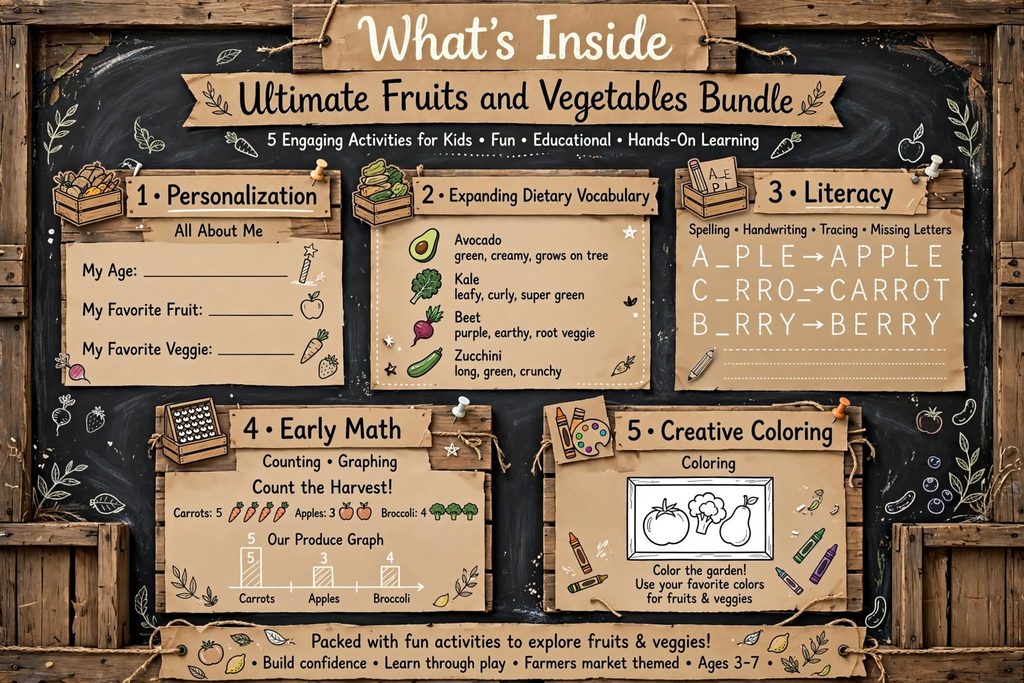
Engaging young minds requires a blend of vibrant visuals and interactive challenges. Our comprehensive “Fruits and Vegetables” PDF bundle is designed to transform early childhood nutrition education into an exciting academic adventure. This extensive workbook goes far beyond simple coloring; it integrates vital foundational skills including literacy, handwriting, logical sequencing, and early mathematics.
By utilizing recognizable, healthy foods, educators and parents can seamlessly build cognitive skills while promoting nutritional awareness. Here is a detailed breakdown of the high-value activities included in this optimized printable bundle.
Personalization and Student Engagement
To immediately invest the child in their learning journey, the workbook opens with a dedicated “All About Me” profile page. This allows students to take ownership of their workbook by filling out their personal details.
- Students can record their specific age and birthday.
- Children are prompted to write down their favorite food, color, pet, movie, sports, and school subject.
- The page concludes with a forward-looking prompt asking, “When I grow up I want to be …”.
Expanding Dietary Vocabulary
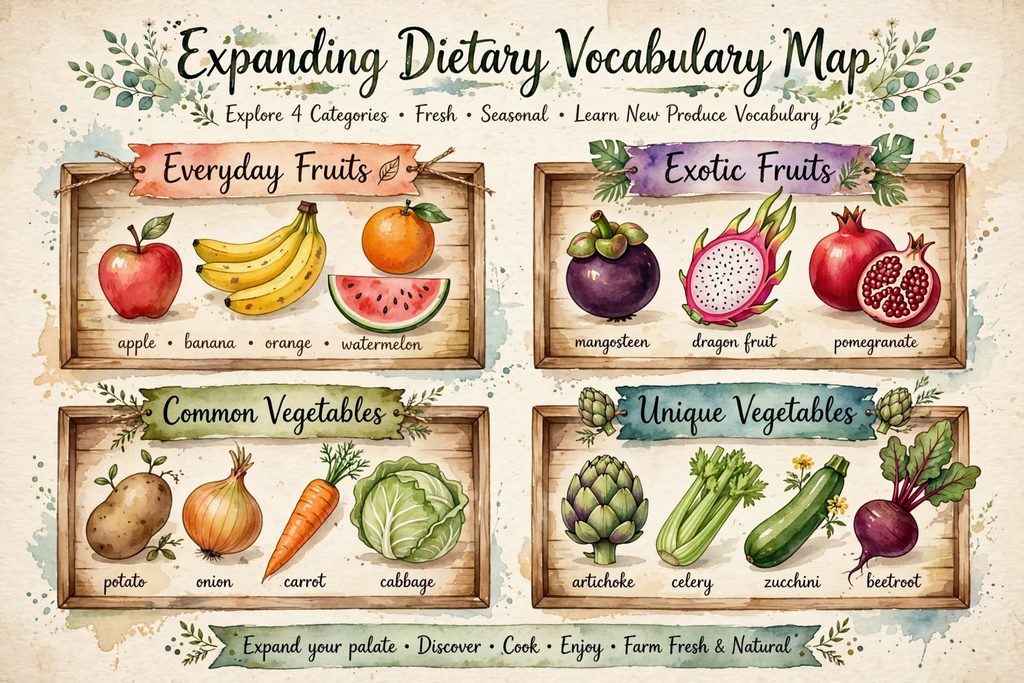
A core focus of this bundle is building a robust vocabulary through visual identification. The worksheets guide children through a diverse botanical journey, categorized clearly into distinct fruit and vegetable sections.
- Everyday Fruits: Students practice identifying household staples like the apple, banana, orange, and watermelon.
- Exotic Fruits: The vocabulary is expanded to include diverse options such as the mangosteen, dragon fruit, and pomegranate.
- Common Vegetables: The vegetable section solidifies recognition of the potato, onion, carrot, and cabbage.
- Unique Vegetables: Children are introduced to the artichoke, celery, zucchini, and beetroot.
To reinforce this vocabulary, the bundle employs multiple testing formats. Students must identify pictures and write the correct name using a provided word bank. In other exercises, they are challenged to draw a physical line to match a printed vegetable name directly to its corresponding image.
Literacy, Spelling, and Handwriting Mastery
Moving beyond simple identification, the workbook features targeted exercises to develop phonics, spelling, and sentence structure.
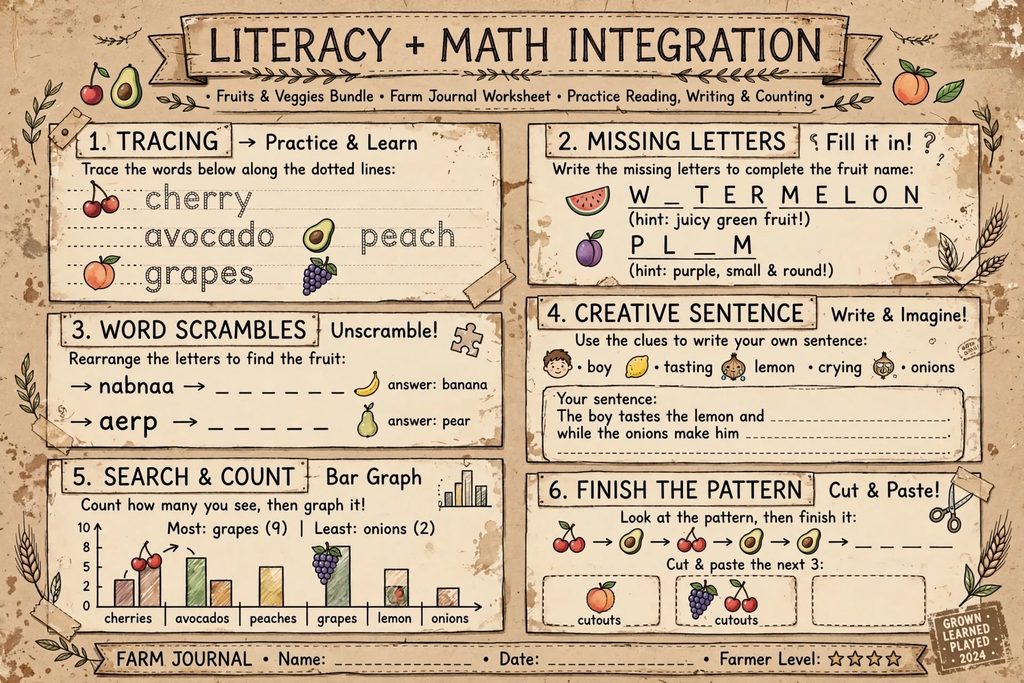
- Tracing Activities: Children develop fine motor skills and muscle memory by tracing fruit names like “cherry,” “avocado,” “peach,” and “grapes” over dotted guidelines.
- Missing Letters: To test phonetic awareness, students must fill in the blanks to complete words, such as deducing “W_TERMELON” and “PL_M”.
- Word Scrambles: Advanced problem-solving is introduced by asking students to unscramble letters and write the correct fruit name on a blank line, translating “nabnaa” into banana and “aerp” into pear.
- Creative Sentence Writing: The bundle provides engaging, sometimes humorous, visual prompts and asks the student to write a descriptive sentence. Prompts include an illustration of a boy making a sour face while tasting a lemon slice, a young girl wearing a chef’s hat while using a hand mixer, crying onions, and a potato wearing glasses.
- Procedural Writing: To practice sequential thought, specific writing prompts ask students, “What are the steps in making an apple pie?” and “What are the steps in making a vegetable dish?”.
Early Mathematics: Counting, Graphing, and Sequencing
Math integration is a standout feature of this workbook, pulling double duty by combining visual discrimination with numerical data entry.
- Search and Count: In the “Let’s Count” activities, students are presented with a densely scattered field of items and must locate, count, and record the exact number of specific targets, such as strawberries, coconuts, or eggplants.
- Data Graphing: Once the items are counted, children learn basic data visualization by filling in a bar graph formatted from 1 up to 10.
- Data Analysis: After graphing, the worksheet challenges their comparative logic by asking, “Which item did you find the most of?” and “Which item did you find the least of?”.
- Pattern Recognition: The “Finish the Pattern” worksheets develop sequential logic. Students must look at an established pattern, cut out the provided images at the bottom of the page, and paste the correct image into the blank square to complete the sequence.
Creative Expression Through Coloring
To ensure the learning process remains highly enjoyable, the bundle concludes with dozens of bold, high-contrast coloring pages suitable for crayons, markers, or colored pencils.
- Fruit Pages: Students can creatively color the voavanga, jackfruit, quince, raspberry, kiwi, and melon.
- Vegetable Pages: The vegetable coloring selection includes detailed line art of garlic, bell pepper, cauliflower, radish, kale, spinach, and chili.
This versatile resource ensures that whether you are teaching phonics, basic arithmetic, or nutritional health, you have the exact printable tool you need readily available at downloadworksheets.com.
↓↓↓Download Here ↓↓↓
