The Big Leap from Memorizing to Truly Understanding Numbers
If you have spent any amount of time around toddlers and preschoolers, you have probably heard them proudly recite their numbers: “One, two, three, four, five, six…” It sounds fantastic, and as parents or teachers, our initial instinct is to celebrate this milestone. However, reciting a string of numbers from memory is much like reciting the lyrics to a song in a foreign language. The child knows the sounds and the order, but they don’t necessarily understand what those sounds actually mean in the physical world.
The real mathematical magic happens when a child bridges the gap between rote memorization and true numerical comprehension. This developmental milestone is called “cardinality”—the understanding that the last number they say when counting a group of items represents the total quantity of that group. Moving a child from simply singing the number song to accurately counting physical objects is one of the most critical transitions in early childhood education. To help them make this massive cognitive leap, we have designed the ultimate basic maths for kids resource: the “Circle the Numbers” printable worksheet bundle.
This massive PDF workbook is completely free and designed to take the frustration out of early counting. Instead of relying on abstract math drills, we use highly engaging, recognizable visual prompts. By presenting children with fun, themed groupings of objects and asking them to identify the correct corresponding digit, we transform an intimidating math lesson into an interactive, visual puzzle.
Why “Circle the Number” is the Ultimate Early Math Exercise
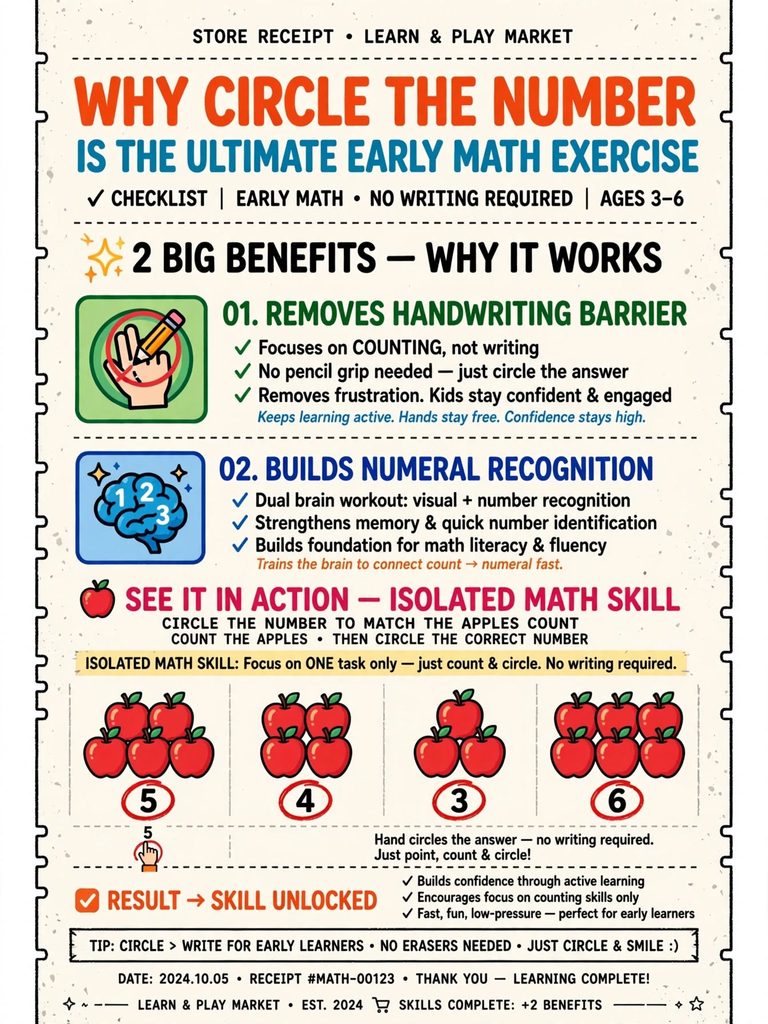
You might be wondering why we chose this specific format. Why not just have children write the number next to the objects? For children aged three to five, fine motor skills are still rapidly developing. Forcing a child to trace or free-hand write the number “8” or “5” requires immense physical concentration. If a child is focusing all their brainpower on how to curve their pencil to draw an “8”, they have very little cognitive energy left over to actually focus on counting the objects.
By providing the numbers in a multiple-choice format directly beneath the objects[cite: 5], we completely remove the physical barrier of handwriting from the math equation. The child only has to count the items and draw a simple circle around the correct number[cite: 5]. This isolates the mathematical skill, allowing the child to experience rapid success and build foundational confidence. Once their counting skills are rock-solid, you can always introduce our alphabets coloring & tracing printables to help them refine those fine motor pencil strokes independently.
Furthermore, this format heavily reinforces numeral recognition. A child may know they are looking at “four” apples, but they must visually scan the row of digits provided (for example: 5, 4, 3, 6) and pick out the correct symbol[cite: 5]. This dual-action brain workout—counting physical objects and translating that amount into an abstract symbol—is the exact foundational framework required for advanced addition and subtraction later in elementary school.
A Deep Dive into the Visual Themes Inside the Workbook
One of the quickest ways to cause a child to lose interest in mathematics is through visual monotony. If every single worksheet looks exactly the same, the brain tunes out. To combat this, we have packed our “Circle the Numbers” bundle with a massive variety of highly detailed, engaging visual themes. Each page features a 3×3 grid, giving the child nine distinct counting challenges per sheet[cite: 5]. Let’s explore the exciting visual categories your child will encounter in this PDF.

Theme 1: The Supermarket Sweep (Food & Groceries)
Kids love food, and using familiar grocery items is a fantastic way to ground abstract math in everyday reality. In the opening sections of the workbook, children will count an array of healthy fruits and vegetables, including clusters of apples, sliced mangoes, bananas, strawberries, cherries, and coconuts[cite: 5]. They will also progress to counting vegetables like broccoli heads, onions, carrots, mushrooms, tomatoes, and pumpkins[cite: 5].
As they move through the pages, the food becomes even more fun. They will count delicious fast foods and treats, including pizza slices, burgers, french fries, hotdogs, sandwiches, croissants, tiered cakes, and donuts[cite: 5]. There is even a dedicated page for proteins, challenging them to count fish, shrimp, crabs, chicken legs, and steaks[cite: 5]. If your child is highly motivated by these fun food themes, you can seamlessly tie this activity into art time by using our coloring pages for preschool and kindergarten to let them color similar delicious treats.
Theme 2: Cafe Culture & Beverages
We also included a highly unique beverage category. Your little learners will carefully count various drinks, including teacups, milk cartons, iced drinks with straws, to-go frappe cups, coffee beans, and even moka pots[cite: 5]. Grouping similar but distinct items helps children refine their visual discrimination skills, ensuring they don’t get tricked when objects are arranged in different spatial patterns.
Theme 3: The Great Outdoors, Camping & Travel
To capture the imaginations of little adventurers, we dedicated several pages to outdoor exploration. Children will practice their one-to-one correspondence by counting rugged items like tents, backpacks, campfires, hiking boots, binoculars, pocket knives, canoes, and mountain peaks[cite: 5]. Counting three campfires or six binoculars feels like a mini-scavenger hunt[cite: 5]. This thematic approach keeps the brain stimulated and proves to the child that math isn’t just for the classroom—it applies to the wilderness, too!
Theme 4: Health, Fitness & Gym Equipment
Physical education and math make a surprisingly excellent team! Our fitness-themed grids challenge students to count items found in a gym. They will circle the correct numbers for groups of dumbbells, kettlebells, jump ropes, whey protein jugs, stationary exercise bikes, running shoes, stopwatches, and flexed biceps[cite: 5]. This is an incredible opportunity to get your child moving. If they count five jump ropes on the page, challenge them to stand up and do five jumping jacks!
Theme 5: Office, Finance, & Technology
Preparing kids for the real world means familiarizing them with everyday adult objects. Our technology and finance pages feature counting grids filled with briefcases, desktop computers, ID badges, rotary phones, stacks of coins, piggy banks, credit cards, calculators, safes, and even financial pie charts and bar graphs[cite: 5]. By counting money bags and cash bundles[cite: 5], you are quietly laying the very first bricks of early financial literacy.
Tackling the “One-to-One Correspondence” Struggle
As you watch your child work through these pages, you might notice a common early-learning hurdle. Often, a child’s mouth will move faster than their finger. They will point at the printed tomatoes or calculators and quickly say, “One, two, three, four, five,” but they only actually touched three objects on the page. This lack of synchronization is completely normal, but it must be gently corrected.
This skill is known as “one-to-one correspondence”—the ability to pair exactly one number word with exactly one physical object. Here are the best, educator-approved strategies to help your child master this using our workbook:
- The “Cross-Out” Method: Give your child a pencil or a crayon. Instead of just pointing at the illustrations, have them physically draw a slash or an ‘X’ through each object as they count it out loud. If they are counting the nine moka pots[cite: 5], crossing them out ensures they never count the same pot twice and never skip one by accident.
- The “Manipulative Match”: If the 2D page is too abstract, bring in 3D tools. If the grid shows four apples[cite: 5], have your child place a physical button, a piece of dry cereal, or a small LEGO brick directly on top of each printed apple. Once every apple is covered, have them count the physical objects as they pull them off the paper. This tactile feedback works wonders for kinesthetic learners.
- Slow the Pace: Model the behavior. Hold your child’s hand, point to the group of backpacks[cite: 5], and deliberately, slowly tap each one, pausing slightly between numbers. Tell them, “We have to wait for our finger to touch the picture before our mouth can say the number.”
How to Set Up the Perfect Math Station at Home
The environment in which a child learns is just as important as the material itself. You want math to feel like an inviting, low-pressure activity rather than a chore. Setting up a dedicated “Math Station” using these printables is incredibly easy and highly effective.
First, we highly recommend laminating these pages or sliding them into heavy-duty clear plastic sheet protectors. Because this PDF contains dozens of grids—from counting single digits like the 1 pocket knife[cite: 5], all the way up to 9 iced drinks or 9 stacked coins[cite: 5]—you want the resource to be endlessly reusable. Hand your child a set of brightly colored dry-erase markers. Let them count, cross out objects, and circle the numbers. When they finish a grid, they can wipe it clean with a cloth and start again tomorrow. This simple act of using a whiteboard marker instantly makes the activity feel more like a game than a test.
Keep the sessions short and sweet. A kindergartener does not need to complete all the pages in this bundle in one sitting. Presenting them with one page (which contains nine separate counting blocks) is the perfect amount of cognitive load for a 10 to 15-minute daily session. If they finish the math quickly and still want to learn, you can pivot to a creative task like our color worksheet modules, letting their brain cool down with some artistic expression.
Bridging Mathematics with Literacy and Logic
The best early childhood education is cross-curricular, meaning subjects blend together naturally. You do not have to isolate math from reading or science. This workbook provides the perfect springboard for comprehensive learning.
Vocabulary Expansion: Do not just let your child count in silence. Ask them to identify the object first. Some items, like the moka pots, briefcases, or bar charts[cite: 5], might be entirely new vocabulary words for a four-year-old. Take a moment to explain what a briefcase is used for before they count them. This seamlessly integrates speech and language development into a mathematical task.
Comparative Logic: Once your child has circled the numbers in a few grids, ask them comparative questions. Point to the box with 8 calculators and the box with 3 piggy banks[cite: 5] and ask, “Which box has more? Which box has less?” This introduces the concept of numerical magnitude. If your child excels at this, they are ready to be challenged by our dedicated kindergarten comparisons worksheets, which teach concepts like bigger/smaller, taller/shorter, and heavier/lighter.
Visual Discrimination: Counting requires a child to differentiate between the foreground object and the white background. You can push this visual perception skill even further. After they finish a math page, hand them our shadow matching worksheets, which force the brain to analyze silhouettes and shapes without the aid of internal details.
Why We Skip Rote Memorization in Favor of Subitizing
You may hear early childhood educators use the word “subitizing.” Subitizing is the ability to instantly recognize the number of objects in a small group without having to count them individually. For example, when you look at a standard playing card or a dice, you don’t count the five dots one by one; your brain instantly registers the pattern as “five.”
Our “Circle the Numbers” worksheets are specifically laid out to encourage this skill. In several of the grids, the objects are arranged in highly structured, symmetrical patterns. For example, the four moka pots, the six ID badges, and the eight daily calendars are arranged in clean, geometric rows and columns[cite: 5]. By repeatedly exposing your child to these structured groupings, their brain will begin to recognize that “two rows of three always equals six” without needing to count them individually. This is a massive shortcut for the brain and forms the absolute foundation of future multiplication skills.
To further reinforce pattern recognition across different subjects, you can pair these math grids with our matching worksheets for kids, which challenge children to find identical pairs and establish logical connections between distinct items.
Understanding the “Math Anxiety” Phenomenon
You might be surprised to learn that math anxiety is a very real, documented psychological phenomenon, and studies show it can begin to take root as early as kindergarten. When children are introduced to mathematics through high-pressure memorization, timed tests, or abstract equations that they cannot visually comprehend, their brains literally register a stress response. This anxiety creates a cognitive block, making it nearly impossible for the child to process numerical logic.
The antidote to early math anxiety is play-based, low-stakes visual learning. This is exactly why the “Circle the Numbers” methodology is so powerful. Because the worksheets look more like a puzzle book or an “I Spy” game, the child’s affective filter remains low. They don’t feel like they are taking a daunting math test; they feel like they are playing a game of observation. When they search a grid to count the intricate line art of wedding rings, tiered cakes, and doves[cite: 5], they are engaging their curiosity rather than their fear. Cultivating this sense of joy and curiosity around numbers in the early years is the single most effective way to ensure your child views themselves as a “math person” for the rest of their academic career.
Addressing Diverse Learning Styles and Special Needs
Just like adults, no two children learn in exactly the same way. The structured, clear layout of these pages makes them incredibly adaptable for various learning profiles, including children with special education needs or developmental delays. For children with ADHD, the heavily segmented 3×3 grid layout[cite: 5] prevents visual overwhelm. Instead of looking at a chaotic page filled with scattered numbers, their brain can focus on one small, bordered box at a time.
For children who require occupational therapy to build hand strength, the act of gripping a crayon to circle the number at the bottom of the grid[cite: 5] provides vital fine motor practice without the extreme frustration of having to write the number from scratch. You can even adapt the worksheets for tactile learners by skipping the pencil altogether. Have the child roll a small ball of playdough and “smash” it onto the correct number instead of circling it. The more ways a child can interact with the material, the deeper their comprehension will become.
Common Questions from Parents and Teachers (FAQs)
What age group is this specific counting workbook designed for?
These worksheets are perfectly tailored for preschool, pre-K, and kindergarten students (typically ages 3 to 6). The visual nature of the grids and the multiple-choice number formats make it ideal for children who are just beginning to grasp cardinality and number recognition.
Do I have to print these pages in color?
No, you do not! We specifically designed the illustrations in this PDF—from the campers to the coffee cups[cite: 5]—using high-contrast, bold black-and-white line art. This ensures the worksheets are incredibly budget-friendly to print at home or in bulk for a classroom, without sacrificing any visual clarity.
My child keeps circling the wrong number. What should I do?
Do not panic, and avoid showing frustration. If they circle a ‘5’ when there are only four apples, simply say, “Let’s count them together one more time, really slowly.” Use the physical “cross-out” method mentioned earlier. Often, mistakes aren’t due to a lack of math understanding, but simply rushing through the exercise. If they are getting frustrated, take a break and switch to a pure creative task, like our color cute animals printables, to reset their mood.
Can I use these printables in my public school classroom?
Absolutely! We strongly believe that high-quality, effective educational resources should be universally accessible. You are entirely free to download, print, and distribute these pages for your classroom, homeschool co-op, or private tutoring sessions.
Explore More Essential Early Education Resources
Your child’s learning adventure is just getting started! Once they have mastered counting and numbering with this bundle, you can seamlessly transition them into literacy. We highly recommend downloading our A-Z alphabet worksheets bundle to give them the exact same level of high-quality, structured practice with their letters. We also offer amazing color identification activities to ensure they have a well-rounded foundation in every core developmental milestone.
Ready to Start Counting? Download Your Free PDF Below!
It is time to make math engaging, visual, and fun. Grab your pencils, print out these high-contrast grids, and watch your child’s numerical confidence soar. Click the secure, high-speed download button below to instantly save and print your complete “Circle the Numbers” workbook.
📥 Download Free “Circle the Numbers” PDF Bundle
↓↓↓Download Here ↓↓↓
