Introduction to Early Childhood Comparative Learning
In early childhood education, comparative analysis serves as an absolute cornerstone for cognitive growth, structural logic, and foundational intelligence. When toddlers, preschoolers, and kindergarteners engage with structured comparative activities, they are not merely completing simple page exercises; they are actively wiring their neural pathways to process spatial relationships, physical properties, and mathematical quantities. The ability to discern between physical extremes—such as identifying whether an object is massive or microscopic, heavy or feather-light, tall or diminutive, thick or slender—forms the bedrock of all subsequent scientific observation and numerical reasoning.

Furthermore, research in developmental psychology consistently demonstrates that children who master comparative vocabulary and visual discrimination during their early foundational years exhibit superior problem-solving skills in primary school mathematics and geometry. Comparing sets of objects teaches young minds how to establish order, recognize patterns, evaluate inequalities, and articulate their reasoning with precision. By integrating comprehensive, multi-thematic worksheet bundles—such as our kindergarten comparisons worksheets—into daily homeschooling routines or formal kindergarten curricula, educators and parents provide children with waterfowl-level tactile and visual stimuli necessary to bridge abstract mathematical concepts with tangible, real-world experiences.
Why Comparative Thinking Matters in Early Childhood Education

Cognitive development during early childhood relies heavily on hands-on exploration and direct observation. Comparison is one of the primary cognitive mechanisms through which children make sense of the world around them. Long before children encounter formal algebraic equations or abstract physics in higher grades, they must intuitively understand what it means for one object to be larger than another, heavier than a companion, taller in stature, or identical in visual pattern. As they progress through foundational math exercises like basic maths for kids, comparative reasoning allows them to quantify differences accurately without feeling overwhelmed by abstract numbers.
When educators and parents introduce comparison worksheets into a child’s daily routine, they are nurturing key developmental milestones: developing visual discrimination, building mathematical intuition, enhancing scientific observation, and refining fine motor control. To keep young learners excited, many teachers pair these printables with creative activities such as color cute animals exercises or general coloring pages for preschool and kindergarten to maintain high enthusiasm and prevent burnout during structured study periods.
Comprehensive Breakdown of the 100-Page Comparison Worksheets Pack
Unlike standard single-topic printables found across the internet, this expansive 100-page collection is meticulously structured into distinct educational modules. Each section targets a specific visual, comparative, or mathematical competency required for early grade success. Below is a comprehensive overview of the eight core learning modules included within this comprehensive printable bundle.

1. Animal & Nature Comparison Modules
The natural world offers some of the most relatable and exciting contexts for young learners. Our animal comparison modules bridge biology and basic math. Children explore parent-and-baby animal matching (such as matching an adult elephant to its calf or a bear to its cub), animal size scaling, and heavy versus light weight comparisons across various wildlife species. These exercises build vocabulary while connecting abstract concepts to living creatures.
2. Height & Length Analysis (Short vs. Tall)
Differentiating vertical dimensions is a core visual skill. Our short-versus-tall worksheets teach children how to evaluate vertical heights and relative lengths using relatable objects, animals, and everyday items. By comparing side-by-side illustrations, children learn directional awareness and spatial vocabulary that translates directly into geometry readiness.
3. Quantity & Number Comparison (Which Has More Food?)
Transitioning from visual size to numerical quantity is a major educational leap. Our “Which Has More Food?” counting-based worksheets require students to tally food items in side-by-side boxes (such as hotdogs, fries, cupcakes, and fruits) and identify which group holds a greater quantity by placing a checkmark or circle. This module seamlessly blends counting practice with comparative decision-making.
4. Size Scaling & Proportion (Circle the Biggest)
Understanding magnitude requires analyzing multiple objects simultaneously. Our multi-tier size scaling exercises challenge children to examine rows of objects with varying proportions, isolate the maximum value, and circle the largest item among a group of distractors, strengthening comparative analysis.
5. Visual Identity & Pattern Matching (Connect the Same Ones)
Visual memory and pattern recognition are tested through our line-drawing matching activities. Children draw clean lines to connect identical shapes, items, and intricate patterns, reinforcing their ability to recognize constant forms across different spatial orientations and visual backgrounds.
6. Direct Matching & Mirror Analysis (Find the Match on the Left)
Side-by-side comparative analysis requires rigorous attention to detail. These worksheets require children to study a target object on the left margin and locate its exact identical clone among a row of similar options, weeding out mirror images and minor discrepancies.
7. Critical Thinking & Observation (Spot What’s Different)
Observation is the bedrock of scientific inquiry. Our spot-the-difference puzzles challenge children to compare side-by-side scenes or objects to identify subtle missing elements, color shifts, or structural alterations, sharpening working memory and visual processing speed.
8. Width, Depth, and Volume (Thick and Thin)
Moving beyond height and weight, understanding thickness is an important dimension of physical reasoning. Our specialized thick-and-thin concept sheets teach children to evaluate physical width across books, pencils, trees, clothing, and everyday household tools.
Pedagogical Framework: How to Guide Young Learners
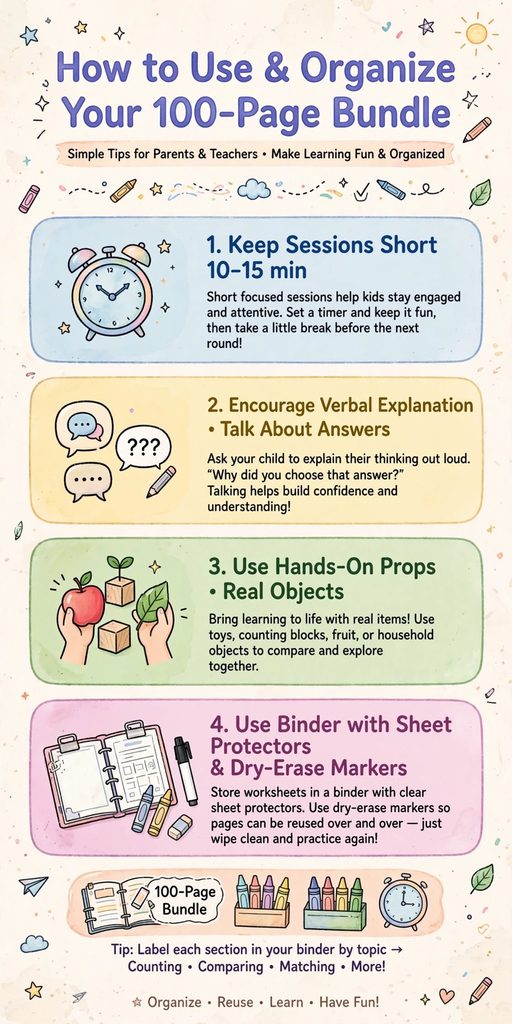
Maximizing the educational value of a 100-page worksheet bundle requires a structured, patient approach. Parents and educators should avoid rushing children through pages. Instead, use these best practices: keep sessions short to prevent cognitive fatigue, encourage children to explain their answers verbally, incorporate hands-on props, and utilize multi-sensory tools like crayons or colored pencils to make learning fun and rewarding.
Tips for Organizing Your Classroom or Homeschool Printable Binder
Managing 100 pages of printable worksheets can be a daunting task for busy parents and teachers. To maximize the utility of this bundle, we highly recommend organizing your printables into a dedicated three-ring binder categorized by skill level. Use plastic sheet protectors for reusable pages, and keep an assortment of dry-erase markers, colored pencils, and safety scissors handy. This setup not only protects your printables from wear and tear but also allows children to select their favorite comparative activities independently, fostering a sense of autonomy and excitement toward daily learning.
Frequently Asked Questions (FAQs)
What age group are these comparison worksheets best suited for?
These printables are ideal for toddlers, preschoolers, kindergarteners, and early primary Grade 1 students developing foundational math, language, and cognitive discrimination skills.
Are these printable worksheets free for classroom and homeschool use?
Yes! Every single worksheet in this 100-page bundle is fully free to download, print, and distribute for educational classroom use, homeschool pods, co-ops, and personal tutoring sessions.
How do comparison worksheets prepare children for advanced mathematics?
Comparing sizes, quantities, and weights builds the intuitive baseline understanding required for mastering numbers, data graphing, inequalities, and algebraic concepts later in elementary school.
Explore More Printable Worksheets and Educational Resources
To further expand your child’s early learning journey, explore our matching worksheets for kids to discover more interactive pairings. You can also check out our shadow matching worksheets or dive into our color identification activities for comprehensive early childhood practice across subjects.
Loading Viewer…
↓↓↓Download Here ↓↓↓
