If there is one milestone that perfectly bridges the gap between a toddler’s early babbling and their growing awareness of the physical world, it is learning to identify colors. Understanding color is rarely a passive event; it is an incredibly active cognitive leap. When a child finally grasps that the word “red” applies to their favorite toy truck, a strawberry, and a stop sign, their ability to categorize and make sense of their environment expands exponentially. Suddenly, they are not just looking at a chaotic world of objects; they are observing a world organized by visual traits.
As early childhood educators and parents, our job is to facilitate this cognitive leap with tools that are engaging, focused, and free of unnecessary distractions. While many modern digital apps attempt to teach colors through rapid-fire animations and loud sound effects, this sensory overload can often hinder actual retention. The most effective way for a young brain to solidify color recognition is through slow, deliberate, tactile practice. This is exactly why we created the ultimate resource for early learners: the massive, completely free “Color Identifications” PDF worksheet bundle.
This carefully constructed workbook doesn’t just ask a child to point at a color. It requires them to physically interact with the concept through multi-sensory activities, including coloring, matching, and critical thinking. Let’s explore how this bundle can transform your preschooler’s understanding of the rainbow and set a solid foundation for their future artistic and academic success.
The Core Philosophy: One Color at a Time
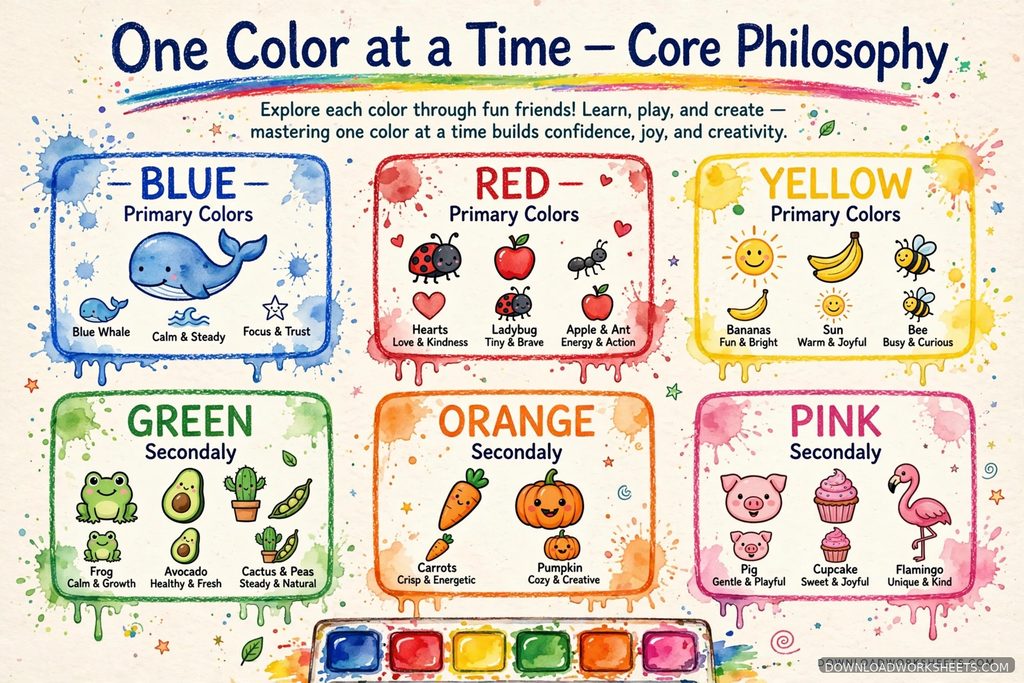
When introducing abstract concepts to young children (typically ages 2 to 4), the golden rule is always isolation. If you hand a three-year-old a box of 64 crayons and a complex coloring page, they will likely create a beautiful, chaotic scribble. While free-form art is essential for creative development, it does not actively teach color discrimination.
Our workbook takes a highly structured approach by isolating a single color on each of the introductory pages. This laser-focused method prevents cognitive overwhelm and allows the child’s brain to firmly anchor the vocabulary word to the visual hue. Here is a breakdown of how we tackle the primary and secondary colors in the PDF:
Mastering the Primary Colors
- The Color Blue: The journey begins with a calming blue. The child is first instructed to color a large, friendly whale[cite: 7]. Below the whale, they face a visual discrimination test. They are presented with a mix of colorful objects—bananas, a bluebird, a pink flower, a blue balloon, and a strawberry[cite: 7]—and must circle only the items that are naturally blue[cite: 7].
- The Color Red: Red is often one of the first colors a child confidently identifies. On this page, students color a trio of simple hearts[cite: 7]. The visual test challenges them to find the red items hidden among yellow rainboots and a purple butterfly[cite: 7]. They must successfully circle the red ladybug, the red apple, and the red ant[cite: 7].
- The Color Yellow: Bright and cheerful, the yellow page asks the child to color a bunch of bananas[cite: 7]. They must then scan the page and circle the naturally yellow items: a sleeping orange cat, a smiling sun, a green turtle, a yellow bee, and a pink candy wrapper[cite: 7].
Exploring Secondary and Earth Tones
Once the primary colors are mastered, the workbook gently introduces secondary colors and earth tones using the exact same predictable, comforting format.
- The Color Green: Students color a large, smiling frog[cite: 7]. They must then differentiate green objects (an avocado, a cactus, and peas in a pod) from red airplanes and orange giraffes[cite: 7]. If your child enjoys this page, you can easily expand their vocabulary by utilizing our vegetables printables to show them even more green foods.
- The Color Orange: Children practice coloring a trio of carrots[cite: 7], followed by identifying an orange, a slice of watermelon, an orange safety vest, a sheep, and a pumpkin[cite: 7].
- The Color Pink: A favorite for many, this page features a cute pig to color[cite: 7]. The child must then find the pink cupcake, flamingo, and jellyfish hidden among other colorful animals[cite: 7].
- The Color Purple: The purple page features a cluster of grapes to color[cite: 7]. The visual test requires finding the purple grapes, eggplant, and flower[cite: 7]. (Note: If your child struggles to identify the eggplant, use this as a great opportunity to cross-reference our fruits and vegetables guide!)
- Earth Tones & Neutrals: We round out the foundational colors by teaching Brown (coloring an acorn and finding a chocolate bar, horse, and bear)[cite: 7], Black (coloring a spiky sea urchin)[cite: 7], and White (coloring a snowman and finding eggs, a cloud, and a bunny)[cite: 7].
Connecting the Dots: The Matching Exercises
Once your child has progressed through the individual color isolation pages, it is time to test their comprehension with comparative logic. The next section of the workbook shifts away from simple coloring and introduces “matching” mechanics.
In these exercises, the left side of the page features a vertical stack of solid colored circles (Red, Yellow, Blue, Purple, Green)[cite: 7]. The right side of the page features a mixed stack of objects[cite: 7]. The child must draw a physical line connecting the solid red circle to the red strawberry, the yellow circle to the yellow bananas, the green circle to the green apple, the purple circle to the purple grapes, and the blue circle to the blueberries[cite: 7].
This is a crucial developmental step. Drawing a line from point A to point B requires hand-eye coordination and fine motor control. Furthermore, it forces the child’s brain to recognize that “color” is an independent attribute that can exist as a solid abstract circle or as a property of a physical object. If your child excels at this matching logic, they are perfectly primed to try our shadow matching worksheets, which test visual perception without the aid of color cues.
Reading Readiness: Word Recognition and Coloring Instructions
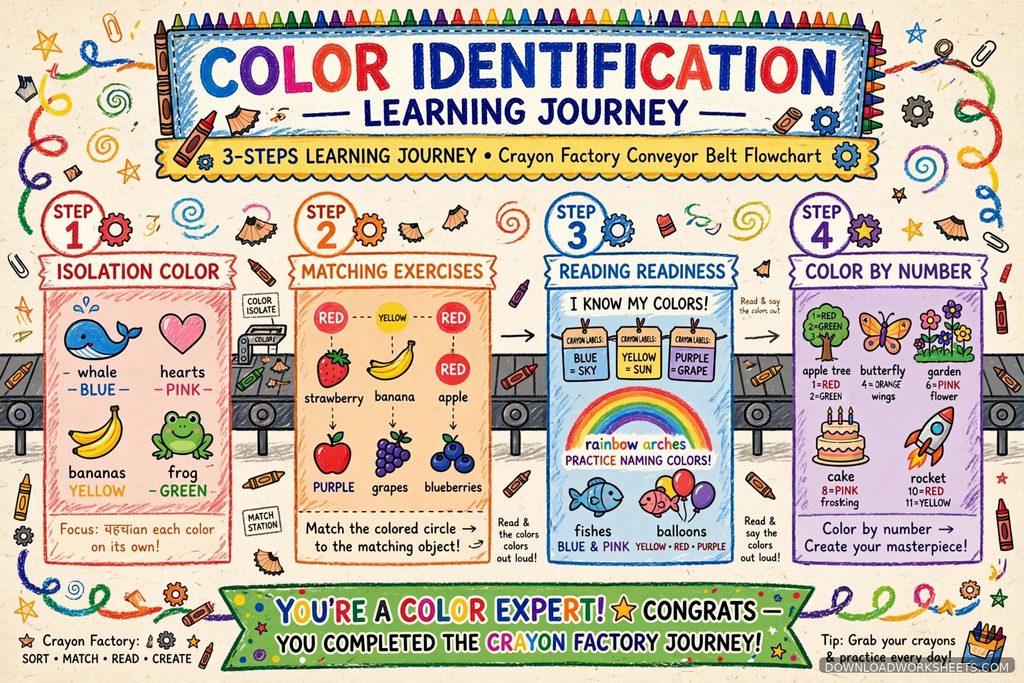
As your child approaches pre-K and kindergarten, the focus must shift from simply identifying colors visually to recognizing the actual written words associated with those colors. The “I Know My Colors” section of the PDF is brilliantly designed to bridge the gap between art and early literacy.
The child is presented with a series of familiar shapes, but there is a catch: the shapes are blank, and a color word is printed directly on them. The child must “read” (or visually recognize) the word to know which crayon to pick up.
- The Crayon Page: A series of blank crayon graphics are labeled with words like “Red,” “Blue,” “Yellow,” “Purple,” “Pink,” “Black,” and “Green”[cite: 7]. This is an excellent exercise for sight-word memorization.
- The Rainbow Page: What better way to teach the spectrum than with a rainbow? Each arch of the rainbow is labeled sequentially: Red, Orange, Yellow, Green, Blue, and Purple[cite: 7]. The child must follow the text to create a scientifically accurate rainbow[cite: 7].
- Shape Recognition: The text-based coloring continues with a page full of blank fishes and a page full of blank balloons, each requiring the child to read the label (e.g., “Orange,” “Pink,” “Yellow”) before applying color[cite: 7].
By forcing the child to pause, look at the letters, and associate the text with a specific crayon in their hand, you are actively laying the groundwork for reading comprehension. To further support their journey into literacy, we highly recommend pairing these exercises with our comprehensive A-Z alphabet worksheets bundle.
The Grand Finale: Color By Number Masterpieces
The final section of the workbook combines every skill the child has learned—number recognition, color vocabulary, fine motor control, and visual discrimination—into a series of highly engaging “Color By Number” puzzles.
Color by number activities are fantastic for developing sustained attention spans. Unlike a standard coloring page where a child might scribble indiscriminately and finish in thirty seconds, a color by number requires focus and discipline. They must constantly reference the “key” at the top of the page, locate the corresponding number in the image, and carefully fill in the boundaries.
The PDF includes several beautiful color-by-number challenges:
- The Apple Tree: Using a key of four colors (1=green, 2=orange, 3=yellow, 4=red), the child brings a simple apple tree to life[cite: 7]. This is a great introduction to the mechanic.
- The Butterfly Garden: A much more complex challenge involving butterflies and a potted plant[cite: 7]. The child must manage six distinct colors (1=pink, 2=purple, 3=yellow, 4=red, 5=orange, 6=brown) to complete the intricate floral scene[cite: 7].
- The Birthday Cake: A fun, celebratory page where a tiered cake is revealed using red, orange, yellow, green, blue, and purple[cite: 7].
- The Outer Space Rocket: For the little astronauts, a thrilling rocket ship scene surrounded by stars, utilizing a key of red, light blue, orange, yellow, and dark blue[cite: 7].
These exercises not only solidify color knowledge but also serve as a stealthy math lesson. If your child is struggling to identify the numbers 1 through 6 in the color keys, you can easily reinforce their numerical skills by downloading our basic maths for kids printables or our popular circle the numbers counting bundle.
Why Visual Discrimination Matters for Future Academics

You might look at the page where your child is circling a green avocado, green cactus, and green peas[cite: 7] and think, “This is just a fun little game.” But what is actually happening in the brain is a highly complex cognitive process known as visual discrimination. Visual discrimination is the ability to recognize details in visual images, allowing a child to identify and categorize similarities and differences.
When a child scans a page looking specifically for the color purple, actively ignoring the yellow duck and the green pear to find the purple eggplant and the purple flower[cite: 7], they are training their eyes and brain to work together to filter out irrelevant information. Why is this so crucial? Because this exact same neurological pathway is required for reading. A child who cannot easily visually discriminate between an orange pumpkin and a red apple[cite: 7] will struggle immensely when asked to discriminate between the letter “b” and the letter “d”, or a “p” and a “q”. By practicing visual sorting through colors now, you are building the neurological scaffolding they will need to become fluent, confident readers in elementary school.
Building Confidence Through Repetition
One of the strongest features of this PDF bundle is its predictable structure. Children, especially toddlers and preschoolers, thrive on routine. When they look at the first page and realize they need to color a blue whale and then circle blue objects[cite: 7], they immediately understand the “rules” of the workbook. When they turn the page to the red section, they don’t need a parent to explain the directions again; they intuitively know they need to color the red hearts and find the red ladybug[cite: 7].
This predictability fosters immense independence and confidence. Instead of feeling confused or requiring constant adult intervention, the child feels like they are in control of their learning environment. This sense of mastery keeps their affective filter low (meaning they aren’t stressed) and makes them far more likely to engage with the material for longer periods of time. If they enjoy this predictable, structured learning, they will also love transitioning into our color cute animals printables, which offer a similarly relaxing and structured creative outlet.
How to Maximize the Value of This Workbook
To ensure your child gets the absolute most out of this massive free PDF, we recommend a few simple strategies to optimize their learning environment:
1. Curate the Crayon Box: When working on the early isolation pages (like the Blue Whale or the Red Hearts)[cite: 7], do not give your child the entire box of crayons. Remove the specific color they need and place it on the table alongside one “wrong” color. Ask them, “Which one is the red crayon?” This forces them to make a deliberate choice before they even touch the paper.
2. Talk Through the Logic: On the visual discrimination pages, don’t just let them circle items in silence. Ask them questions. When looking at the “Green” page[cite: 7], point to the red airplane and ask, “Why aren’t we circling the airplane? What color is it?” Having them verbally articulate that the airplane is red, not green, dramatically increases their retention.
3. Use High-Quality Art Supplies: A frustrated child will quickly lose interest. Ensure their crayons or markers are high quality, brightly pigmented, and easy to grip. A dull, waxy crayon that barely leaves a mark will make the color-by-number pages feel like a chore rather than a fun puzzle.
4. Extend the Lesson Off the Page: Once your child finishes a page—for example, the “Yellow” page—take the learning into the real world. Go on a “Yellow Scavenger Hunt” around the house or the classroom. Can they find a yellow toy? A yellow shirt? A yellow block? If you want to keep the learning on paper but need a change of pace, transition to our coloring pages for preschool and kindergarten to let them apply their new color knowledge creatively.
Answers to Common Questions (FAQs)
What is the best age to start using this color identification workbook?
This bundle is highly adaptable. The simple coloring and circling pages (like finding the pink pig) are perfect for toddlers as young as 2.5 to 3 years old. The text-based reading pages and the complex color-by-number puzzles are better suited for pre-K and kindergarten students (ages 4 to 6).
My child keeps coloring outside the lines on the color-by-number pages. Should I correct them?
Absolutely not! Fine motor control is a developmental process. The primary goal of this workbook is cognitive color recognition and matching the number to the correct crayon. If the butterfly is colored with the correct orange and purple crayon, the child has successfully completed the cognitive task, regardless of how messy the borders are.
Can I print these worksheets in black and white?
For the majority of the workbook, no. Because the primary goal is teaching color recognition, printing the visual discrimination pages (where they must find the red ladybug or the yellow bee) in grayscale will completely defeat the purpose of the exercise. However, the “I Know My Colors” text-based pages and the Color By Number pages are naturally black and white and will print perfectly without using colored ink.
Can I use this PDF in my daycare or preschool classroom?
Yes! We provide these high-quality resources completely free of charge. You are welcome to download, print, and distribute these pages for any educational, non-commercial setting. We highly recommend laminating the matching pages and using dry-erase markers so multiple students can practice drawing lines between the colors and the fruits!
Continue the Learning Adventure!
Mastering colors is just one piece of the early education puzzle. Once your child is confidently identifying their reds, blues, and yellows, they are ready to tackle broader comparative concepts. Check out our kindergarten comparisons worksheets to teach them about size, weight, and spatial reasoning.
Ready to Brighten Up Learning? Download the PDF Now!
Stop relying on flashy apps to teach foundational skills. Give your child the tactile, focused practice they need to confidently master their colors. Click the secure download button below to instantly access the complete “Color Identifications” printable bundle and start exploring the rainbow today
↓↓↓Download Here ↓↓↓
