There is a beautiful moment in every child’s development when the world starts to click together, and learning opposites is a massive leap forward in their cognitive journey. Grasping contrasting concepts helps children categorize the world, communicate their feelings more effectively, and develop stronger descriptive vocabularies. The “Opposites.pdf” collection is a stunning, 26-page visual guide designed to make these abstract concepts tangible, joyful, and easy to understand for early learners.
This comprehensive collection covers a vast array of opposite pairs, categorized thoughtfully to move from simple spatial awareness to more complex emotional and physical states. Let’s explore the wonderful themes and lessons found within these opposites worksheets.
Foundational Spatial and Action Opposites Worksheets
The journey begins with the most fundamental spatial concepts that toddlers interact with daily. The opposites worksheets introduce the concepts of “In/Out” using an adorable illustration of a dog inside and outside its doghouse. Children learn “On/Off” by looking at a little girl interacting with a yellow lamp, and “Up/Down” with a playful cat navigating a blue chair.
As the concepts progress, children explore movement and positioning. They learn “Go/Stop” with the help of a friendly police officer holding respective signs. The worksheets beautifully illustrate “Front/Back” using a young girl facing forward and away, and “Full/Empty” by contrasting a box overflowing with vegetables against a completely bare wooden crate. Other crucial spatial concepts include “High/Low” (featuring children on a trampoline), “Under/Over” (with a cat navigating a wooden stool), and “Inside/Outside” (showing a cute cat exploring a cardboard box).
Exploring the Physical World: Opposites Worksheets

Understanding the physical properties of the world is a key part of early science and sensory development. The opposites worksheets brilliantly capture temperature differences with “Hot/Cold,” showing a girl shivering in the snow versus sitting by a warm campfire. “Dry/Wet” is illustrated with a child cheerfully holding a pink umbrella in the rain, contrasted with a boy standing soaked in a puddle.
Children are introduced to size and dimension through “Big/Small” (comparing a basketball to a baseball) and “Tall/Short” and “Long/Short” (using different sizes of gardening shovels). The collection also tackles tactile and physical properties, teaching “Rough/Smooth” with a jagged rock versus a smooth green ball, and “Heavy/Light” by contrasting a sturdy wooden chair with a delicate, colorful feather.
Time, Emotion, and State of Being: Opposites Worksheets

Beyond the physical world, the collection helps children navigate time, routines, and emotions. “Light/Dark” is cleverly shown with a boy holding a flashlight in a bright room versus a pitch-black room. The passage of time is taught through “Day/Night” (showing a sunny window versus a starry night window) and “Awake/Asleep” (featuring a little girl playing versus peacefully sleeping on a pillow).
Emotional intelligence is gently nurtured as well. Children learn “Happy/Sad” and “Laughing/Crying” through expressive illustrations of young boys. The worksheets also touch on broader concepts like “Good/Bad” (a boy neatly throwing trash away versus littering) and “Funny/Serious,” helping children build the vocabulary they need to express their inner world and understand the behavior of those around them.
Advanced Contrasts for Growing Minds
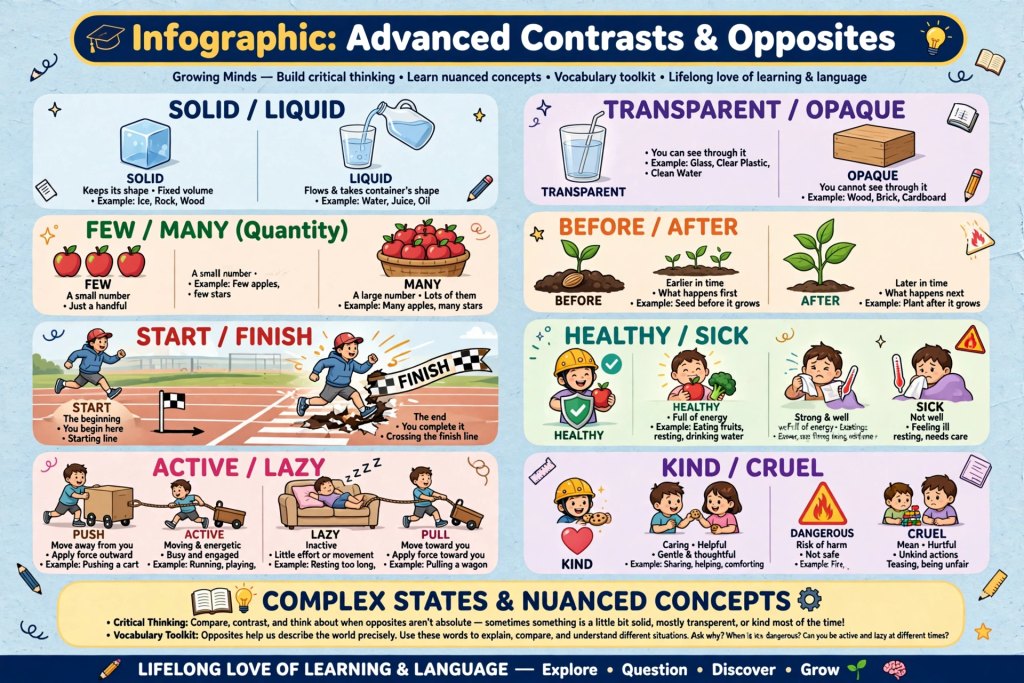
As children master the basics, the opposites worksheets introduce more nuanced concepts that challenge their critical thinking. They explore the differences between “Solid/Liquid” and “Transparent/Opaque.” They learn about quantity with “Few/Many,” and sequence with “Before/After” and “Start/Finish” (illustrated with a boy at a starting line and crossing a finish line ribbon).
The collection even touches on complex states like “Healthy/Sick,” “Active/Lazy,” and “Safe/Dangerous,” providing a rich, well-rounded vocabulary toolkit. From the simple “Push/Pull” to the thoughtful “Kind/Cruel,” these 25 pages of beautiful, engaging opposites worksheets offer an incredible foundation for a child’s lifelong love of learning and language.
↓↓↓Download Here ↓↓↓
