One of the most exciting milestones in early childhood is when a child begins to understand their place in the physical world. Developing spatial awareness helps children navigate their environment, follow directions, and build a foundation for more complex mathematical concepts later on. The “Positions.pdf” file provides a wonderful, 22-page collection of positions worksheets designed to teach these essential spatial relationships through gentle, engaging illustrations. Let’s explore the heartwarming activities included in this curriculum.
Inside and Outside: The Basics of Space
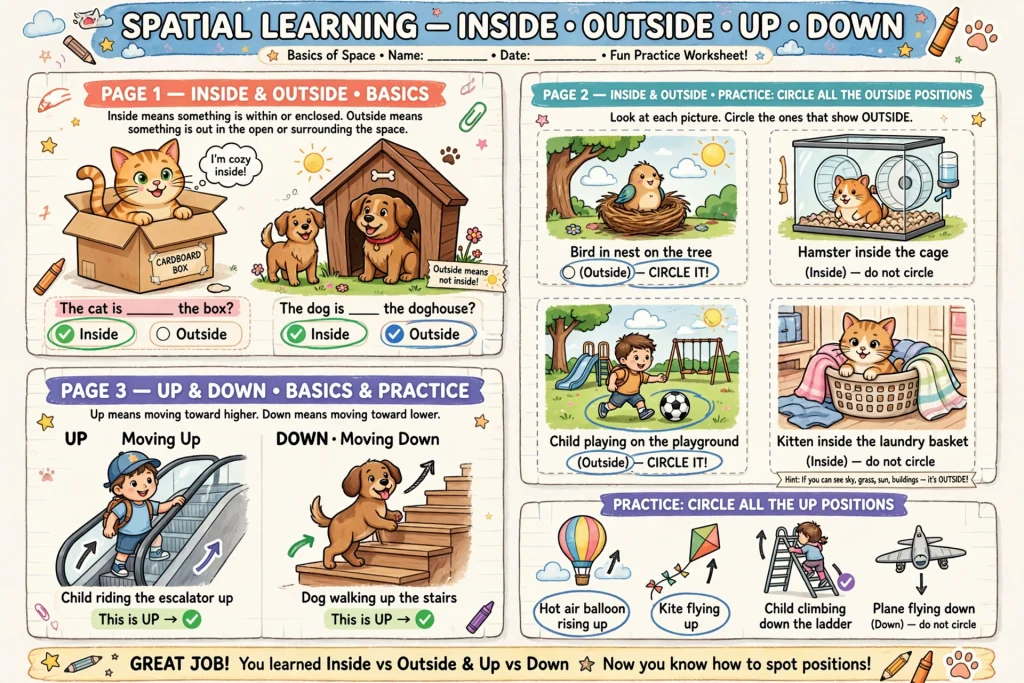
The collection begins with the most fundamental spatial concepts: “Inside and Outside.” Across three dedicated pages, children are introduced to cute, relatable scenarios. They see a playful cat sitting inside a cardboard box, and then sitting outside of it. They observe a friendly dog safe inside its doghouse, and then standing outside.
The worksheets transition from passive observation to active participation. Children are asked to “Choose the right answer for each,” selecting between “Inside” and “Outside” labels next to the familiar illustrations. Finally, a cognitive evaluation page asks them to scan a mixed grid of images and “Circle all the ‘outside’ positions,” reinforcing their newly acquired vocabulary.
Moving Up and Down
Next, the curriculum explores vertical movement with the “Up and Down” positions worksheets. To make these concepts tangible, the pages use relatable imagery: a child riding an escalator up, and another riding it down. They also show a dog confidently walking up a set of stairs, contrasted with the dog walking down.
Similar to the previous section, children practice choosing the correct “Up” or “Down” label for specific images. They then complete a visual scanning exercise where they must identify and “Circle all the ‘up’ positions” from a scattered assortment of graphics.
Navigating Over, Under, Above, and Below
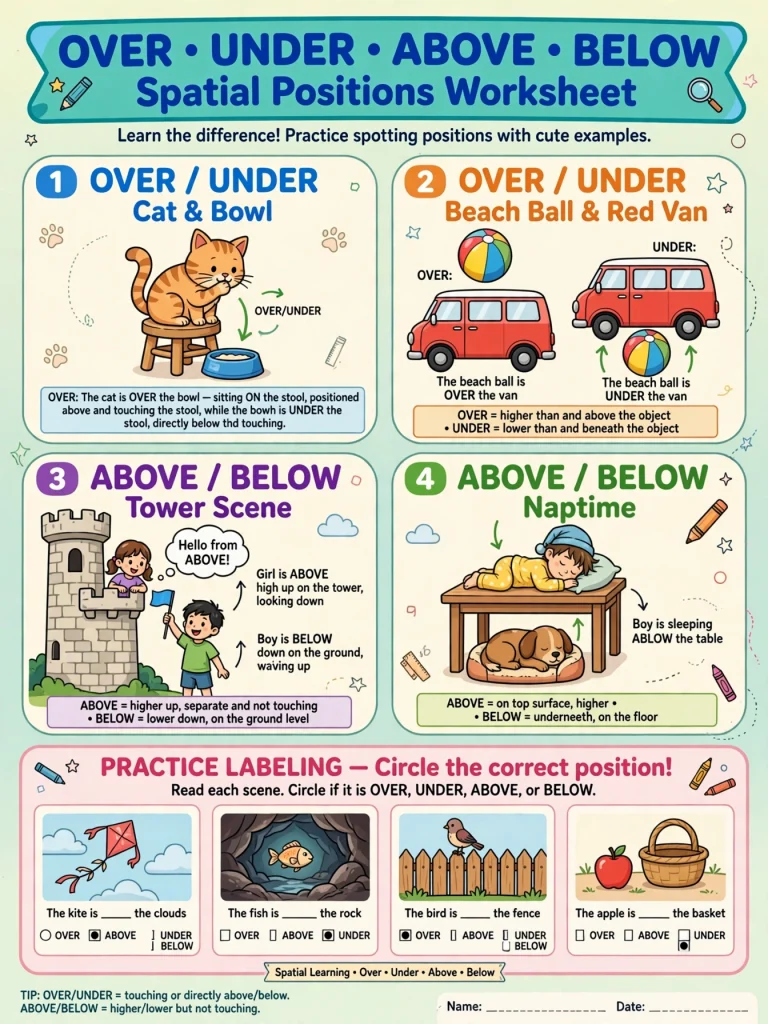
The positions worksheets then guide children through more nuanced spatial relationships. In the “Over and Under” section, they see a cat sitting on top of a wooden stool (over), and then playfully eating from a bowl beneath it (under). They also see a colorful beach ball positioned over a red van, and then under it. They practice labeling these images and then must “Circle all the ‘over’ positions” on a mixed activity page.
The subtle difference between over/under and “Above and Below” is tackled next. Children view an illustration of a tall tower with a girl looking out from above, while a boy waves from below. They also see a boy sleeping on a table (above), while a dog sleeps beneath it (below). They practice labeling and then complete a page asking them to “Circle all the ‘below’ positions”.
Exploring Near, Far, Left, Right, Top, and Bottom
The final sections of the curriculum cover essential concepts for everyday navigation. “Near and Far” is beautifully illustrated with a girl standing close to her pony (near), and then standing at a distance (far). It also shows a sailboat and a small bird in the sky to represent distance. Children must label these and then “Circle all the ‘near’ positions”.
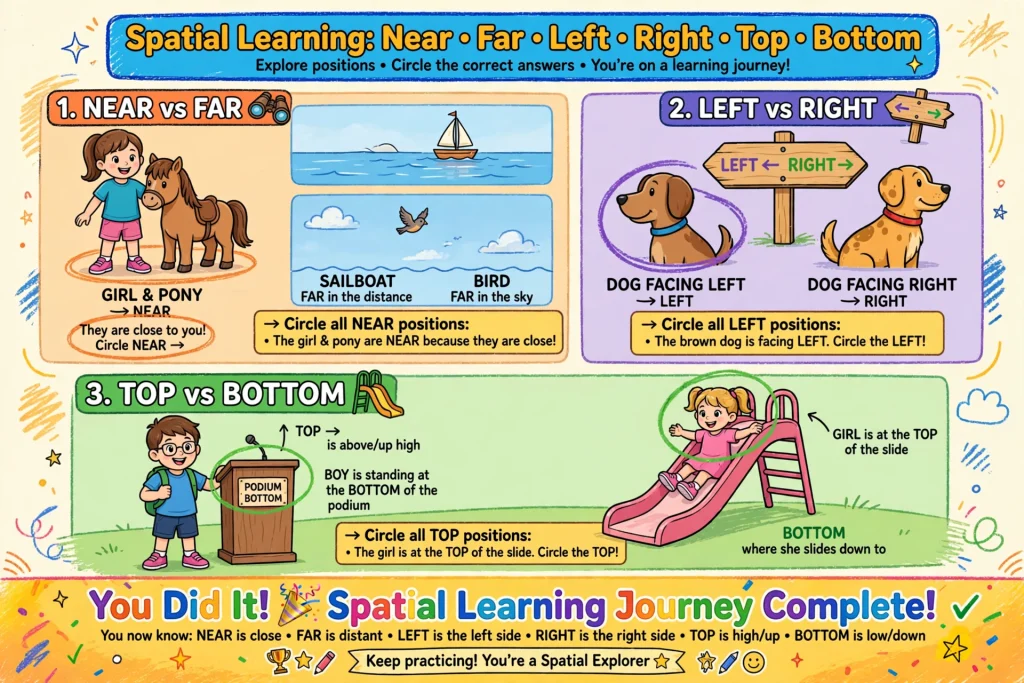
Directional awareness is taught using “Left and Right”. The worksheets use a pointing hand, a wooden directional sign, and a dog facing different directions to help children distinguish between left and right. They practice choosing the correct label and then complete a page to “Circle all the ‘left’ positions”.
Finally, the collection concludes with “Top and Bottom”. Children view a boy standing at the bottom of a podium and then at the top. They also see a girl at the top of a playground slide, and then sliding down to the bottom. The curriculum wraps up by having them choose the correct labels and “Circle all the ‘top’ positions,” ensuring a comprehensive, joyful end to their spatial learning journey.
↓↓↓Download Here ↓↓↓
