In early childhood education, teaching the alphabet requires far more than simple rote memorization. To truly internalize letter shapes, sounds, and spatial relationships, young learners need a multifaceted approach that engages different cognitive and motor pathways. This guide delves into an exceptional 26-page educational resource, the “English-Alphabet-Worksheet.pdf,” which provides a masterclass in comprehensive literacy instruction. Rather than focusing on a single skill, every single page in this workbook is divided into four distinct pedagogical zones: “Color it,” “Trace and Write,” “Find and Circle,” and “Beginning Sound.” By combining creative expression, guided handwriting, visual discrimination, and phonemic awareness into one cohesive layout, this English alphabet worksheet collection stands as a premier tool for early educators and parents.
Phase 1: Visual Familiarization in the “Color it” Zone

Every page in this 26-page workbook begins at the top with a section titled “Color it”. This quadrant introduces the child to the target letter through massive, hollow block outlines of both the uppercase and lowercase forms. For example, on the very first page, children are presented with a giant “Aa” alongside the bold red text of the letter itself. This section serves as a low-pressure, highly engaging entry point. Before a child is asked to hold a pencil perfectly or memorize stroke order, they are allowed to use crayons or markers to freely color inside the lines. This builds basic fine motor control and visual familiarity with the letter’s fundamental geometry.
Phase 2: Guided Motor Skills in “Trace and Write”
Directly beneath the coloring section, the worksheet transitions into structured handwriting practice in the “Trace and Write” zone. This section is brilliantly designed to scaffold a child’s writing abilities using primary gridlines (a solid top line, dashed midline, and solid baseline).
Crucially, this section does not just provide dotted lines for tracing; it actively teaches proper stroke order. The first tracing example of the uppercase letter is overlaid with numbered arrows, explicitly instructing the child on where to place their pencil and which direction to move. For instance, the uppercase “B” shows an initial downward stroke labeled “1,” followed by two curved strokes labeled “2” and “3”. The uppercase “M” clearly outlines four distinct directional strokes.
The “Trace and Write” sequence is highly methodical:
- The child traces the uppercase letter several times along dotted lines.
- The child moves to the second grid row to trace the lowercase letter, complete with its own specific numbered directional arrows (e.g., showing the curve and drop of the lowercase “a” or “g”).
Phase 3: Cognitive Filtering with “Find and Circle”
Once the physical act of writing is practiced, the English alphabet worksheet challenges the child’s cognitive processing and visual discrimination in the “Find and Circle” zone. This section presents a randomized, colorful jumble of various uppercase and lowercase letters scattered across the page.

The student’s task is to scan this chaotic field and circle only the specific letter they are currently studying. For example, on the “H” page, the child must sift through distractors like a green “n,” an orange “A,” and a red “Z” to successfully locate and circle the blue “H,” green “h,” and red “H”. This activity is vital for developing reading fluency, as it trains the brain to rapidly identify specific typographic shapes regardless of size, color, or surrounding visual clutter.
Phase 4: Phonemic Awareness with “Beginning Sound”
The final quadrant at the bottom of every page bridges the gap between abstract letter shapes and real-world language. The “Beginning Sound” section features vibrant, full-color illustrations of three distinct objects or animals that start with the target letter, accompanied by the written word. This anchors the phonetic sound of the letter in the child’s mind.
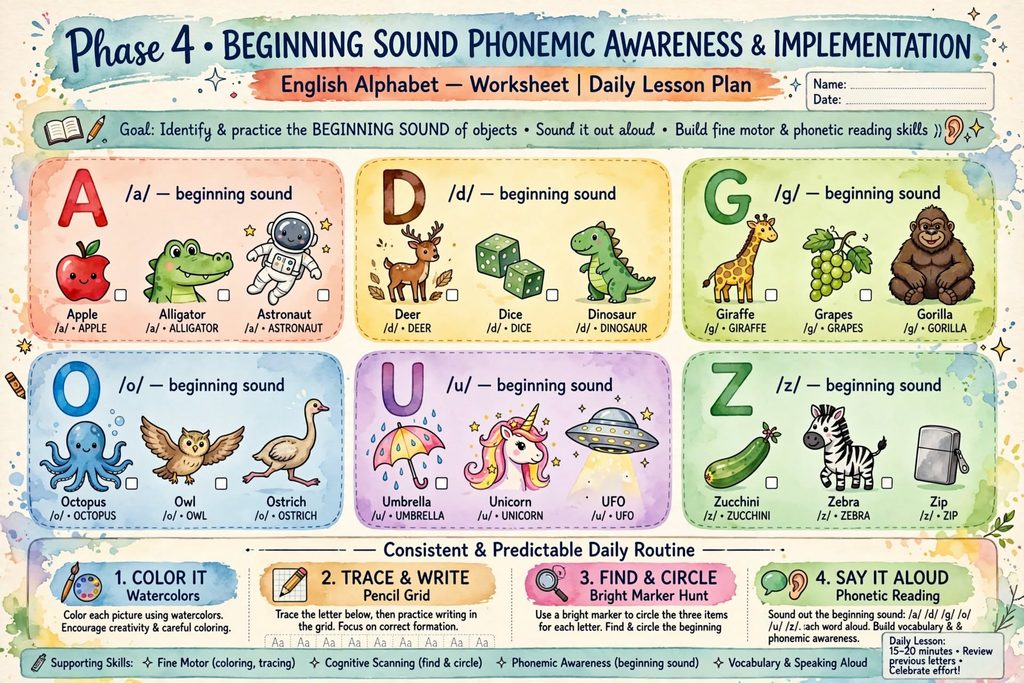
The vocabulary chosen for this workbook is wonderfully diverse and highly engaging for children. Notable examples across the curriculum include:
- Letter A: A shiny red Apple, a smiling green Alligator, and a floating Astronaut.
- Letter D: A brown Deer, a pair of Dice, and a green Dinosaur.
- Letter G: A tall Giraffe, a bunch of green Grapes, and a large Gorilla.
- Letter O: A blue Octopus, a flying Owl, and a running Ostrich.
- Letter U: A pink and yellow Umbrella, a magical Unicorn, and a hovering UFO.
- Letter Z: A green Zucchini, a striped Zebra, and a metal Zip.
Implementing the English Alphabet Worksheet Curriculum
The true power of this specific English alphabet worksheet collection is its consistent, predictable routine. Because every single page from A to Z follows the exact same four-step structure (Color it, Trace and Write, Find and Circle, Beginning Sound), children quickly learn the expectations of the assignment. This reduces anxiety and allows them to focus entirely on mastering the new letter rather than trying to understand new instructions.
Educators can stretch a single page into a comprehensive daily lesson plan. A teacher might start the morning allowing the child to complete the “Color it” section with watercolors, transition to pencil work for the “Trace and Write” grid, use a brightly colored marker for the “Find and Circle” hunt, and conclude the lesson by sounding out the “Beginning Sound” vocabulary words together aloud. By touching on visual art, fine motor control, cognitive scanning, and phonetic reading all on a single page, this workbook provides an unparalleled foundation for early childhood literacy.
↓↓↓Download Here ↓↓↓
