Moving from kindergarten to first grade is a major academic milestone. While the summer break offers well-deserved rest, it also brings the risk of learning loss. Without regular practice, foundational reading and math skills can easily fade. To bridge this gap and keep young minds engaged, this comprehensive printable workbook provides targeted, daily exercises disguised as fun summer activities. It covers all the essential literacy, math, and logical reasoning skills required for a smooth transition into first-grade academics.
Literacy, Phonics, and Sight Word Mastery
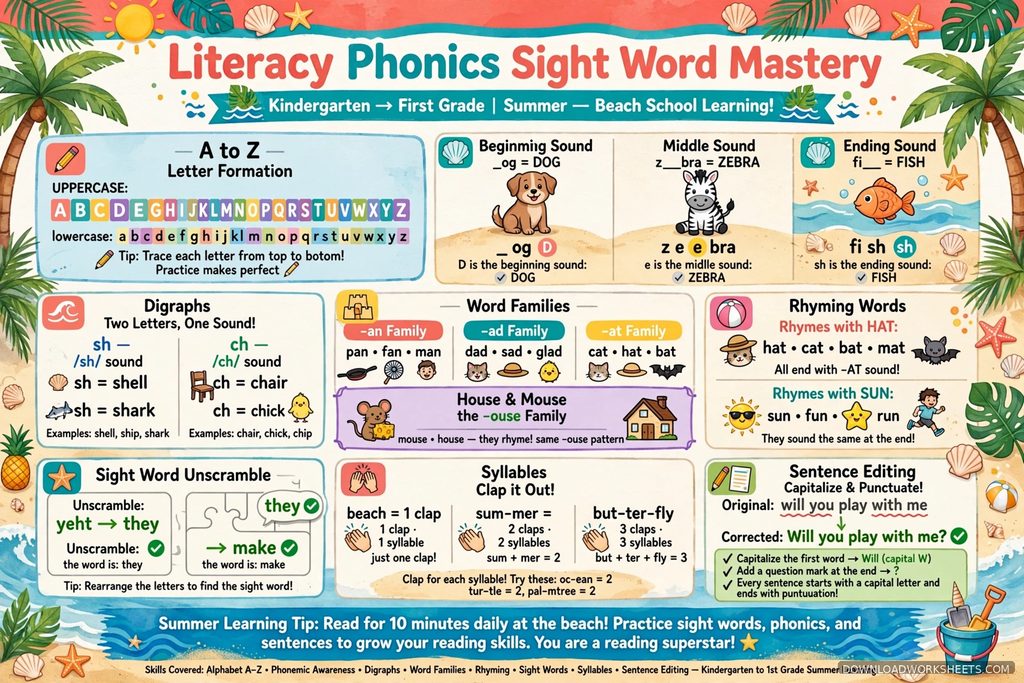
Reading fluency relies heavily on recognizing letter patterns and memorizing high-frequency words. This workbook breaks down literacy into manageable, interactive tasks:
- Alphabet and Letter Formation: Students reinforce their handwriting by writing both uppercase and lowercase letters from A to Z.
- Phonemic Awareness: Children practice identifying missing beginning, middle, and ending sounds for familiar vocabulary words like “dog”, “zebra”, and “fish”. The packet also targets digraphs, challenging kids to circle words starting with /sh/ and underline those starting with /ch/.
- Word Families and Rhyming: The exercises introduce word families (such as -an, -ad, and -at) and teach children how changing a single initial letter creates a new word, like turning “mouse” into “house”. Students are also prompted to write their own lists of words that rhyme with “hat” and “sun”[cite: 9].
- Sight Word Decoding: High-frequency words are practiced through letter-shape boxes and anagrams, where kids must unscramble mixed-up sight words like “yeht” (they) and “akme” (make)[cite: 9].
- Syllables and Sentence Structure: Kids clap out and identify the number of syllables in given words[cite: 9]. They also act as editors, correcting capitalization and punctuation in simple sentences such as “will you play with me” and “i like ice cream”[cite: 9].
Number Sense and Foundational Mathematics

First grade introduces more complex arithmetic, making it vital for children to have a concrete understanding of numbers and values. The summer packet approaches math through visual and numerical exercises:
- Counting and Sequencing: The workbook requires students to write numbers from 0 to 20 and practice counting all the way to 100 by 1s, 5s, and 10s[cite: 9].
- Comparing and Graphing: Children analyze pairs of numbers to circle the greater value[cite: 9]. They also gather data by counting summer-themed objects and completing a visual graph to determine which category has the most or least[cite: 9].
- Addition and Subtraction Mechanics: Students solve visual subtraction problems and practice writing multiple different equations that result in the same sum (e.g., finding different ways to make 3, 4, or 5)[cite: 9].
- Making 10: A crucial mental math skill, this activity asks kids to find the missing addend to reach ten, such as solving 3 + __ = 10[cite: 9].
- Introduction to Base 10: Children learn to group numbers by drawing and interpreting tens (rods) and ones (units) to solve equations like 10 + 2 = 12 and 10 + 7 = 17[cite: 9].
- Word Problems and Logic: Real-world scenarios challenge kids to draw pictures and calculate totals, such as figuring out the total number of birds if there are 3 in a tree and 4 on a pond[cite: 9]. They also evaluate whether given math equations are true or false using a “thumbs up” or “thumbs down” system[cite: 9].
Geometry, Spatial Awareness, and Life Skills

Understanding the physical environment and one’s own personal identity are key components of early childhood education:
- Shape Recognition: The workbook tasks children with labeling 2D flat shapes (squares, hexagons, circles, triangles) and 3D solid shapes (cones, cubes, cylinders, spheres)[cite: 9]. They must also categorize shapes correctly as either flat or 3-D[cite: 9].
- Spatial Position Words: Using an ocean theme, kids identify the location of sea creatures by circling correct positional words such as under, behind, over, in front of, above, and next to[cite: 9].
- Weight Comparison: Logical reasoning is developed by asking children to evaluate everyday objects and circle which item would be heavier or lighter in reality[cite: 9].
- Personal Information: A dedicated page ensures kids memorize their critical safety information by writing out their first and last name, home address, birthday, and phone number[cite: 9].
- Self-Expression: Open-ended drawing and writing prompts encourage children to articulate their thoughts, asking them what they love about summer and what they are looking forward to most in first grade[cite: 9].
↓↓↓Download Here ↓↓↓
