For early childhood educators and parents, finding activities that simultaneously develop cognitive sequencing and fine motor control is an ongoing priority. Traditional dot-to-dot worksheets remain one of the most effective, accessible tools for achieving these developmental milestones. By requiring a child to draw continuous lines between specific plot points, these exercises seamlessly blend rote memorization (like counting or reciting the alphabet) with the physical dexterity required for early handwriting. This guide provides a detailed exploration of a comprehensive educational resource titled “Dot-to-Dot.pdf,” a magnificent workbook filled with diverse connect-the-dots puzzles designed to challenge and delight young learners.
The “Dot-to-Dot” document is structured to provide a wide variety of subjects, ranging from adorable animals to everyday objects and nature scenes. Crucially, the workbook splits its pedagogical focus into two distinct developmental areas: numeric sequencing (counting from 1 to 20) and alphabetical sequencing (tracing letters from A to Z). By alternating between numbers and letters, these dot-to-dot worksheets ensure that children receive a well-rounded cognitive workout while maintaining high levels of engagement through exciting visual reveals.
The Pedagogical Benefits of Connect-the-Dots
Before examining the specific puzzles within the workbook, it is important to understand the multifaceted educational benefits of dot-to-dot worksheets. When a child completes one of these pages, they are executing several critical skills simultaneously:
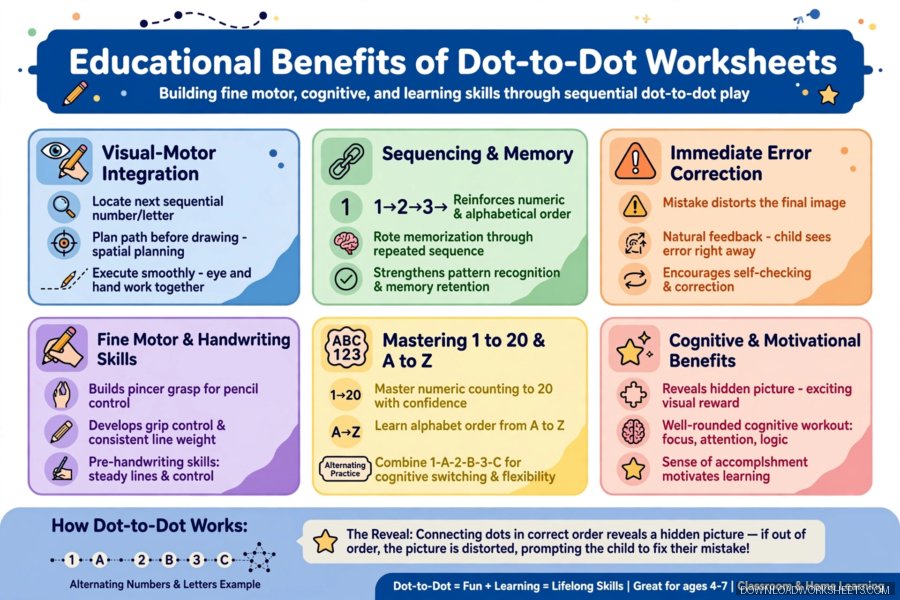
- Visual-Motor Integration: The child must visually locate the next sequential number or letter, plan the physical path their pencil must take, and execute that movement smoothly.
- Sequencing and Rote Memorization: To reveal the hidden picture, the child must accurately recall the correct order of numbers or the English alphabet. A single mistake in the sequence distorts the final image, providing immediate, natural error correction.
- Grip Control and Line Weight: Drawing continuous lines between small plot points requires immense pencil control, helping children develop the pincer grasp necessary for fluent handwriting.
Mastering Numeric Sequencing: 1 to 20 Puzzles
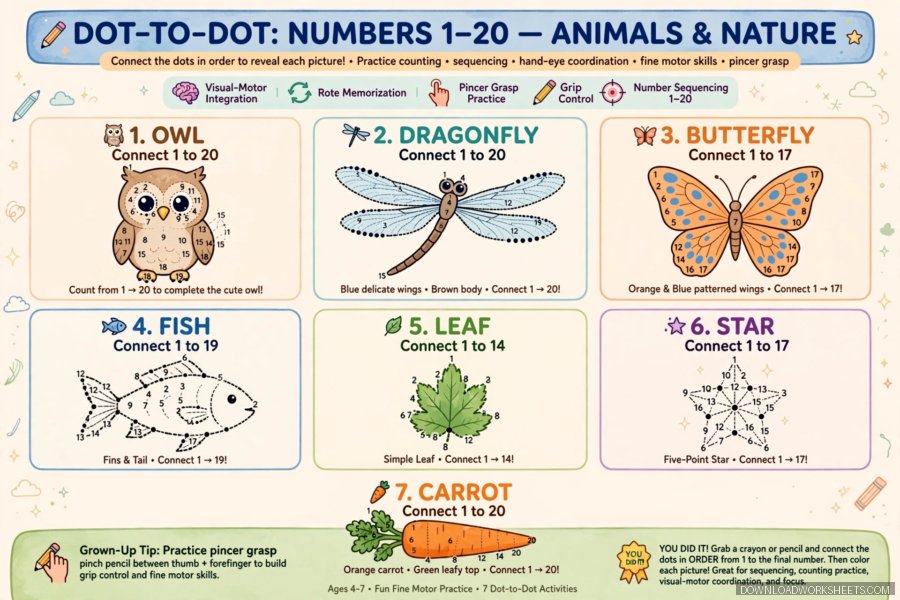
The foundational aspect of this workbook relies on numeric sequencing. These specific dot-to-dot worksheets vary in length, with some offering shorter sequences for beginners and others stretching up to the number 20 to challenge more advanced counters.
Animals and Insects
Children are naturally drawn to wildlife, and this workbook capitalizes on that interest with several beautifully designed animal puzzles. One of the most striking pages features a large owl with prominent, cute black eyes and a small triangular beak. To complete the outline of the owl’s head and body, children must connect the dots from 1 all the way to 20.
The insect kingdom is also well-represented. The workbook includes a highly detailed dragonfly puzzle that requires connecting dots 1 through 20 to form its long body and delicate wings. To assist young artists, this page brilliantly includes a full-color reference image in the corner, showing the completed dragonfly with blue wings and a brown body. Similarly, a beautiful butterfly puzzle tasks children with connecting dots 1 through 17 to outline its sprawling wings. Like the dragonfly, the butterfly page includes a colored reference image featuring vibrant orange and blue wing patterns. For aquatic lovers, a delightful fish puzzle requires counting and connecting dots 1 through 19 to complete its fins and tail.
Nature and Objects
Beyond animals, the numeric dot-to-dot worksheets explore the natural world and recognizable shapes. For example, children can complete a large, simple leaf by connecting dots 1 through 14. A brilliant celestial puzzle allows children to draw a classic five-pointed star by connecting dots 1 through 17.
One of the most engaging nature-themed puzzles is the carrot. To complete this vegetable, children must connect the dots up to the number 20, outlining the tapered root and the bushy leaves at the top. This page is particularly helpful as it features a bright reference illustration of an orange carrot with a green leafy top, providing children with clear coloring instructions once the pencil work is finished.
Mastering Alphabetical Sequencing: A to Z Puzzles
While numbers are vital, alphabetical fluency is equally critical for early literacy. To address this, the workbook intersperses several dot-to-dot worksheets that rely entirely on the English alphabet, requiring the child to connect letters from A to Z to reveal the hidden image.
These alphabetical puzzles are excellent for children who are preparing to read, as they force the child to mentally recite the alphabet while physically scanning the page for the next correct letter. Notable A to Z puzzles in this collection include:
- The Teddy Bear: A classic childhood staple, this puzzle challenges the student to connect points A through Z to form the rounded ears, head, and body of a plush teddy bear.
- The Snail: This clever design requires the child to navigate the letters A through Z to outline the spiraling shell and the body of a crawling snail.
- The Tiered Tree: A beautiful, symmetrical puzzle that uses the full alphabet (A-Z) to form the sweeping, swooping branches of a tiered tree or fountain shape.
Implementing Dot-to-Dot Worksheets in the Classroom
To maximize the utility of these dot-to-dot worksheets, educators and parents should view them as multi-step activities rather than simple busywork. The learning does not stop once the final dot is connected.
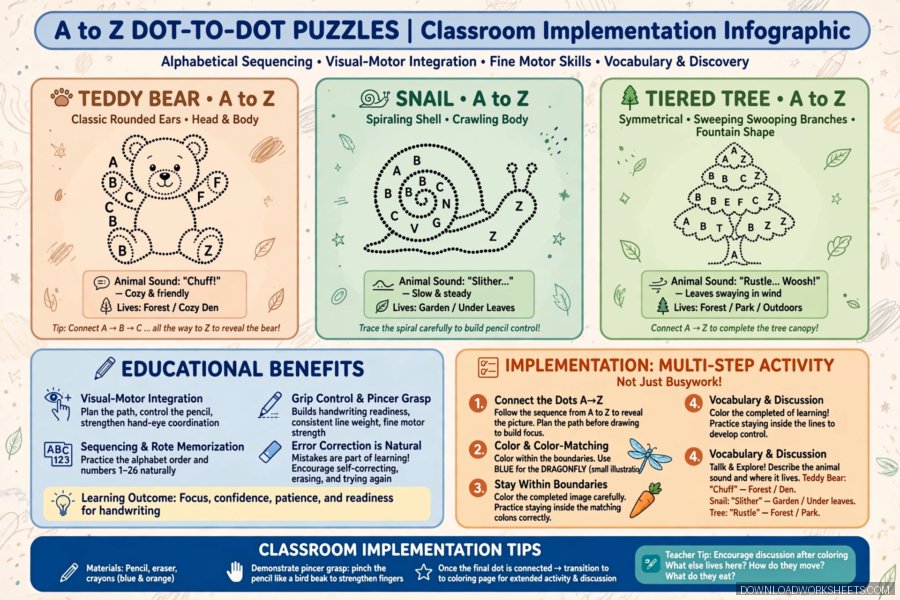
Once a child successfully connects 1 to 20 on the owl or A to Z on the snail, the worksheet transitions into a coloring page. Educators should encourage children to use the provided reference images, such as the blue dragonfly or the orange carrot, to practice color matching and staying within the boundaries they just drew. Furthermore, teachers can use these pages to spark vocabulary lessons—asking the child to verbally describe the animal they just revealed, what sound it makes, or where it lives in nature.
The “Dot-to-Dot.pdf” is a masterfully curated resource that hits multiple developmental targets simultaneously. By offering a balanced mix of numeric puzzles up to 20 and full A to Z alphabetical challenges, these dot-to-dot worksheets provide a comprehensive, highly engaging pathway for young learners to solidify their counting, memorize their letters, and perfect their pencil control, all while revealing delightful illustrations.
↓↓↓Download Here ↓↓↓
