Introducing children to the world of mathematics is one of the most exciting milestones in early childhood education. At the core of this journey is the concept of addition. When children first learn to combine quantities, they are not just memorizing numbers; they are building the foundational logic required for advanced problem-solving, critical thinking, and everyday life skills. Utilizing carefully structured math addition worksheets is one of the most effective ways to guide young learners through this transition.
In this comprehensive guide, we will explore a highly effective, multi-phased approach to teaching addition. By moving systematically from visual counting to spatial frameworks like ten-frames, educators and parents can ensure that children develop a deep, intuitive understanding of mathematics. Let’s break down the essential phases of a successful early math curriculum.
Phase 1: Adding by Counting Pictures
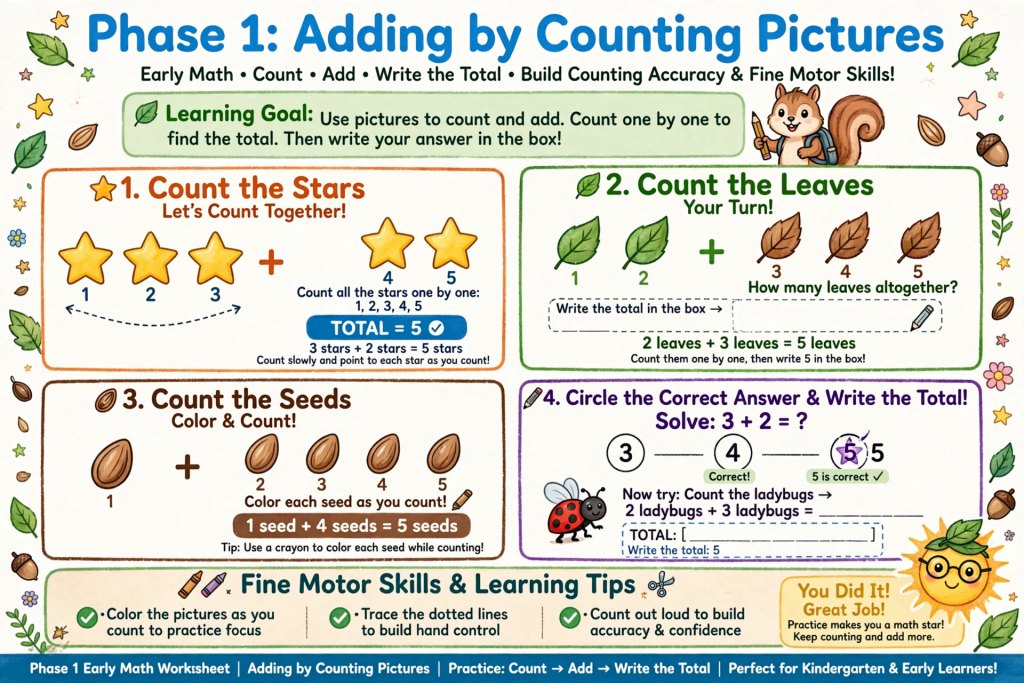
Before introducing abstract numerical symbols, children must understand the physical reality of combining two groups of objects. Adding by counting pictures serves as the perfect, stress-free entry point into mathematical equations.
The Power of Visual Representation
Young children are highly visual learners. When they see a group of three stars next to a group of two stars, they can physically count the items one by one to find the total. High-quality worksheets utilize engaging illustrations—such as cute animals, everyday items, or nature-inspired objects like seeds and leaves—to capture a child’s attention. By drawing a line from a visual equation to the correct resulting number, children build fine motor skills while reinforcing their counting accuracy.
Interactive Problem Solving
Interactive tasks, such as coloring the correct number out of a lineup of choices, turn a standard math problem into an engaging art activity. When children are asked to count visual items and write the total inside a designated box, they are actively participating in the equation, bridging the gap between counting and writing.
Phase 2: Transitioning to Adding by Numbers
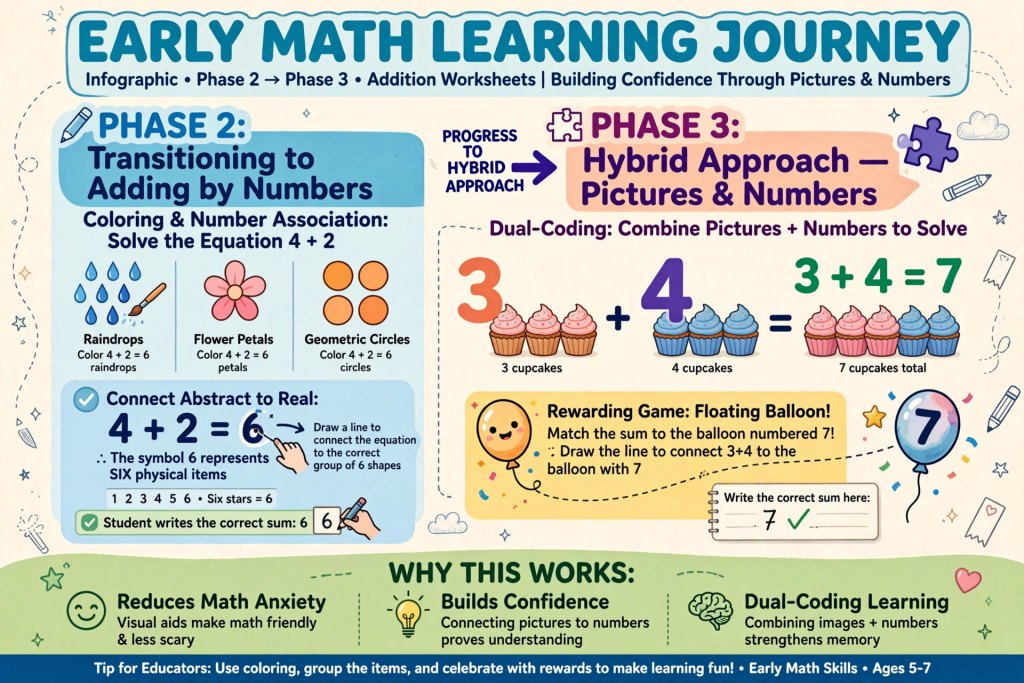
Once a child is confident in counting physical objects, the curriculum must gently transition them to recognizing and utilizing numerical symbols. This phase is crucial for developing numerical fluency.
Coloring and Number Association
Worksheets in this phase often blend numbers with creative coloring tasks. For example, a child might be asked to solve an equation like “4 + 2” and then color a corresponding number of raindrops, flower petals, or geometric circles. This method proves that the child understands that the abstract symbol “6” correlates to exactly six physical items to be colored.
Connecting Equations to Quantities
Another highly effective exercise involves solving a numerical equation and then drawing a line to connect the answer to a group containing the correct quantity of shapes. Writing the correct sum inside a fun illustration, like a floating balloon, makes the repetition of solving simple arithmetic feel like a rewarding game rather than a chore.
Phase 3: The Hybrid Approach of Pictures and Numbers
To solidify a child’s understanding, the best math addition worksheets combine both pictures and numbers in the same equation. This hybrid approach caters to children who are transitioning between visual reliance and symbolic recognition.
Reinforcing Abstract Concepts with Visual Aids
In these exercises, a problem might show the number “3” next to a picture of three cupcakes, added to the number “4” next to four cupcakes. This dual-coding method ensures that if a child forgets what the symbol “4” means, they can immediately reference the illustration. It builds immense confidence and drastically reduces math anxiety.
Phase 4: Circling the Correct Number for Cognitive Evaluation
Evaluation is a critical step in the learning process. The “Circle the Correct Number” phase tests a child’s ability to count a group of objects and select the right answer from a multiple-choice format.
Developing Process of Elimination Skills
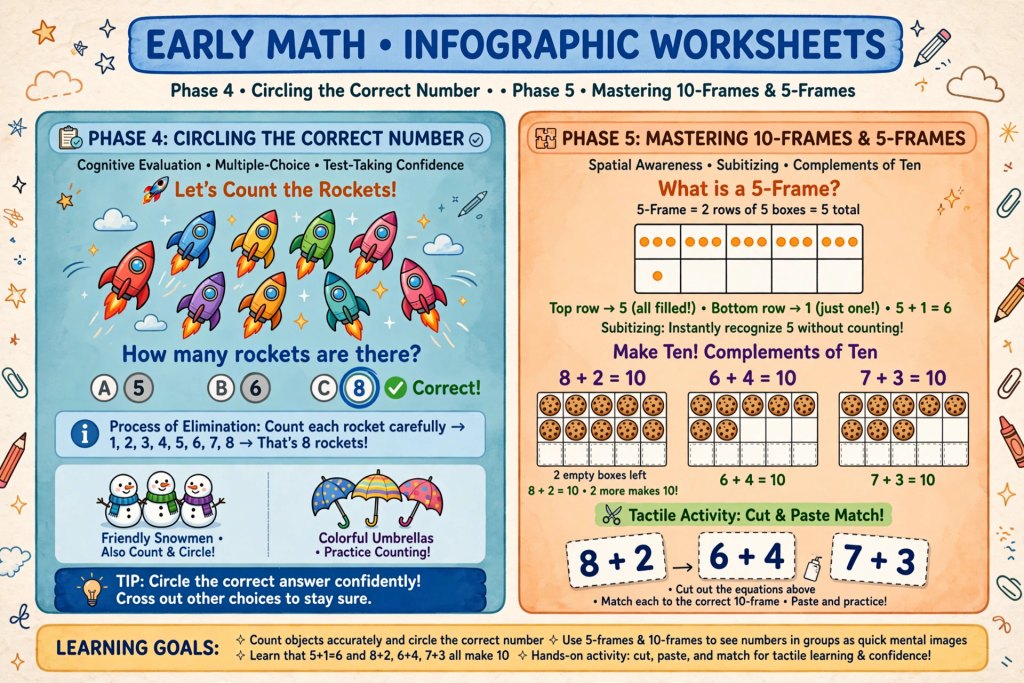
By presenting a child with a group of illustrated items—such as flying rockets, friendly snowmen, or colorful umbrellas—and providing three possible answers, the child learns to trust their counting. If they count eight rockets but the choices are 5, 6, or 8, they learn to confidently circle the 8. This multiple-choice format is excellent for building test-taking confidence at an early age.
Phase 5: Mastering 10-Frames and 5-Frames
Perhaps the most powerful tool in early mathematics is the ten-frame (and its smaller counterpart, the five-frame). A ten-frame is a simple graphic tool: a rectangle divided into two rows of five boxes. It fundamentally changes how children visualize numbers.
Building Spatial Awareness and Subitizing
Instead of counting items one by one, ten-frames teach children to “subitize”—the ability to instantly recognize the number of objects in a small group without counting. When a child sees a ten-frame with the top row completely filled, they instantly know that represents five. If there is one dot on the bottom row, they know 5 + 1 = 6.
Understanding Complements of 10
Ten-frames are essential for teaching the complements of ten (e.g., 8+2, 6+4, 7+3). By seeing how many empty boxes are left in the frame, children visually grasp what is needed to “make ten.” Worksheets that ask students to cut and paste equations into matching frames, or count illustrated cookies within a frame, turn advanced spatial reasoning into a highly accessible, tactile activity.
Conclusion: Setting the Stage for Mathematical Success
Teaching addition is not a race; it is a gradual, layered process. By utilizing comprehensive math addition worksheets that progress from visual counting, to hybrid numerical equations, and finally to spatial ten-frames, parents and educators provide children with a robust mathematical toolkit. These joyful, heartwarming activities ensure that a child’s first steps into math are filled with curiosity, confidence, and success.
↓↓↓Download Here ↓↓↓
