In an increasingly digital world, cursive handwriting remains a vital cognitive exercise that connects the hand and brain through fluid, continuous movements. For educators and parents looking to introduce the elegance of joined-up handwriting to young learners, the “Cursive Alphabet Trace And Write” workbook provides a masterful, highly visual blueprint. Rather than treating cursive as a tedious chore, this curriculum transforms the learning process into a guided, sensory-rich experience by pairing precise motor skill scaffolding with vibrant visual anchors.
The Mechanics of the Swoop and Loop
The foundation of cursive lies in understanding continuous stroke order. This workbook excels at breaking down complex loops into highly manageable steps. At the top of every page, students are presented with massive models of the target uppercase and lowercase letters, overlaid with explicit directional arrows.
- On the “Bb” page, the uppercase letter features a clear downward stroke labeled “1,” followed by an upward arrow guiding the hand seamlessly into the classic double loops.
- The letter “Cc” utilizes numbered arrows to carefully direct the student through the sweeping, counter-clockwise curves of both the uppercase and lowercase forms.
- For letters requiring ascenders and descenders, the guide arrows trace the exact path the pencil must take, mapping out the graceful sweep of the “Ll” and the tricky foundational loops of the “Kk”.
Structured Scaffolding on the Tracing Grid
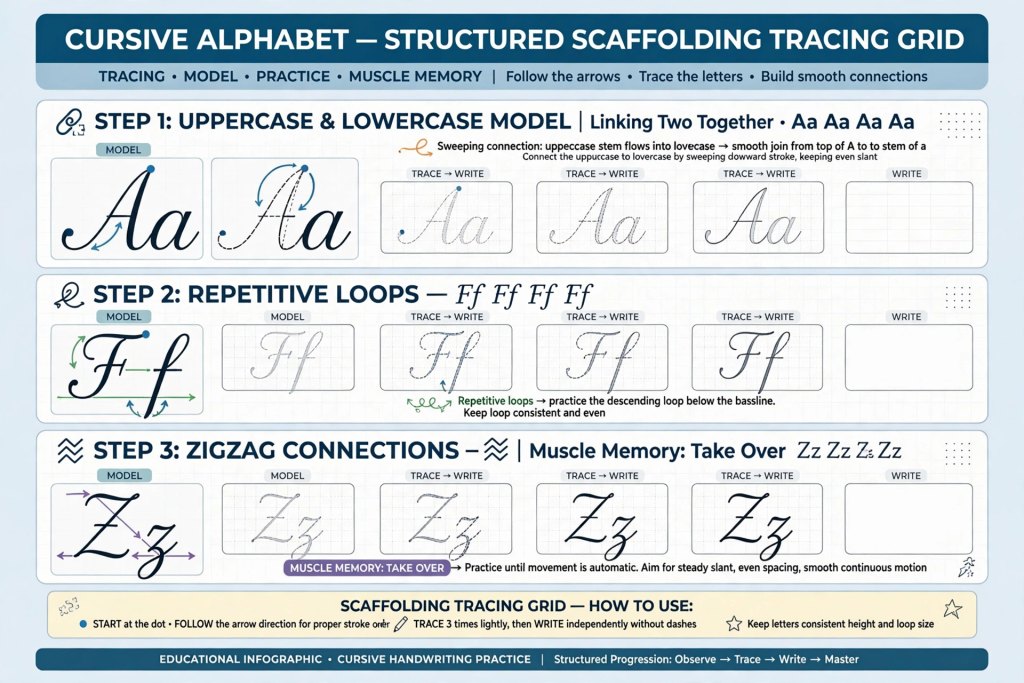
Beneath the large directional models, the workbook provides a rigorous, structured tracing grid. This section allows the muscle memory to take over. Students do not just trace random letters; they follow a specific progression. They begin by tracing a row of standalone uppercase letters, move to a row of lowercase letters, and finally practice linking the two together. For example, the grids explicitly guide students through the linked patterns of “Aa Aa Aa Aa”, the sweeping connections of “Ff Ff Ff Ff”, and the repetitive loops of “Zz Zz Zz Zz”.
Visual Anchors for Kinesthetic Learners
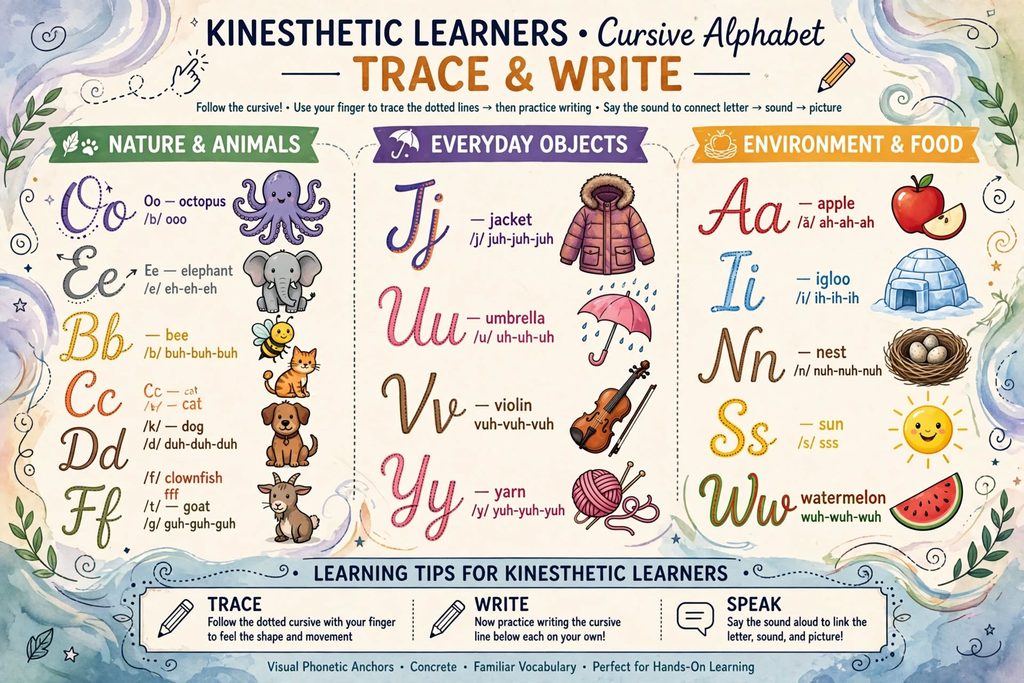
To keep the repetitive nature of handwriting engaging, the curriculum pairs every single cursive letter with a bright, full-color illustration. This acts as a visual and phonetic anchor, grounding the abstract swirls of cursive ink to concrete, familiar vocabulary.
- Nature and Animals: The sweeping “Oo” is matched with a purple octopus, while the “Ee” features a large grey elephant. Other delightful animal pairings include a bee for “Bb”, a cat for “Cc”, a dog for “Dd”, a clownfish for “Ff”, a goat for “Gg”, a lion for “Ll”, a mouse for “Mm”, a penguin for “Pp”, a rabbit for “Rr”, and a green turtle for “Tt”.
- Everyday Objects: The workbook reinforces letters with familiar items, pairing “Jj” with a purple and orange winter jacket, “Uu” with a pink umbrella, “Vv” with a wooden violin, and “Yy” with a ball of pink yarn and knitting needles.
- Environment and Food: Students associate “Aa” with a red apple and a slice, “Ii” with an ice-block igloo, “Nn” with a bird’s nest holding three eggs, “Ss” with a bright yellow sun, and “Ww” with a slice of watermelon.
Conquering the Hardest Letters
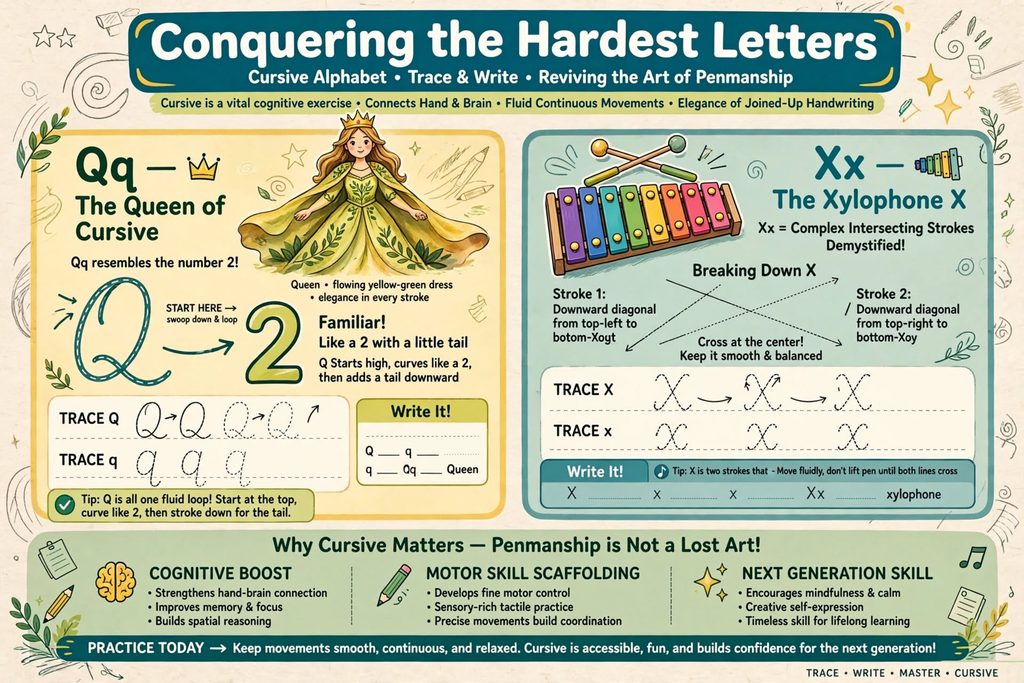
Cursive is notorious for letters that look vastly different from their standard print counterparts. This workbook tackles these challenging characters head-on by making them approachable. The uppercase “Qq,” which famously resembles a massive number two, is paired with a beautiful illustration of a queen in a flowing yellow and green dress. The complex, intersecting strokes of “Xx” are demystified alongside a colorful wooden xylophone and mallets. By combining exact stroke guidance with engaging visuals, this cursive alphabet trace and write resource ensures that penmanship is not a lost art, but a vibrant, accessible skill for the next generation.this cursive alphabet trace and write resource ensures that penmanship is not a lost art, but a vibrant, accessible skill for the next generation.
↓↓↓Download Here ↓↓↓
